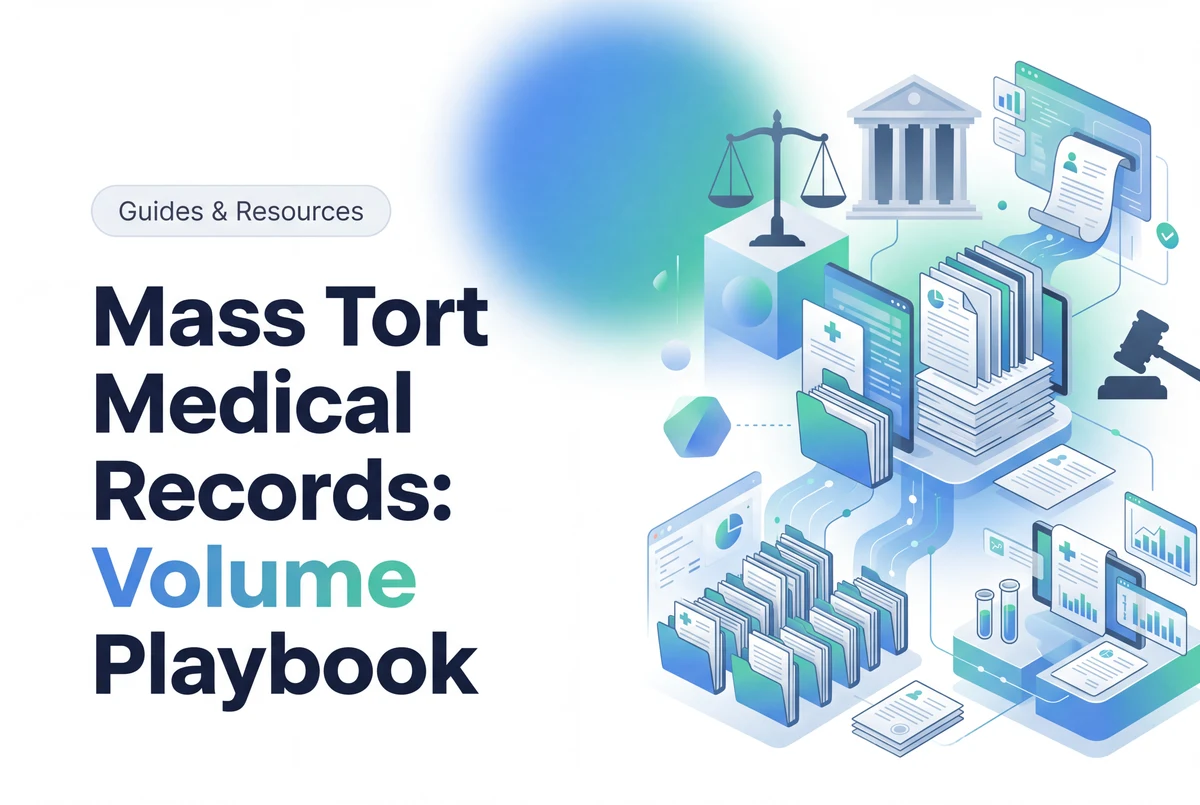
Mass Tort Medical Records: Volume Playbook

CEO & Founder at LlamaLab
Mass Tort Medical Records: A Volume Strategy Playbook for 2026
As of January 2026, 158 active MDL dockets carry 197,965 pending actions across the federal court system. At the industry manual review rate of roughly 50 pages per hour, a single 5,000-page case requires approximately 100 hours of review time. Across a docket of hundreds or thousands of claimants, manual tracking quickly stalls operations.
The top 25 MDLs account for 95.2% of all pending cases. The volume is concentrated in a handful of mass torts, including GLP-1, paraquat, NEC, hair relaxers, Camp Lejeune, and PFAS. Firms handling those dockets face the same operational challenge: getting medical records at scale, from dozens of provider types across multiple states, without running into month-long delays per claimant.
Pending actions across 158 active federal MDLs (Jan 2026)
Industry-standard manual medical record review rate
Average turnaround time with modern retrieval systems
The Volume Problem
Single-plaintiff personal injury retrieval differs fundamentally from mass tort retrieval. A standard injury case might involve three to five providers within one state's compliance framework. Mass tort cases involve records spread across hospitals, specialists, imaging centers, and rehabilitation facilities, each with different turnaround timelines, fee structures, and release requirements.
Multi-state litigation adds procedural hurdles. A national mass tort docket requires navigating different state laws, consent requirements, release procedures, and copy fee schedules at once. An authorization form accepted in Texas can be rejected in California, while a fee structure acceptable in Florida may exceed statutory limits in New York.
Provider backlogs and hospital staffing shortages create further friction. Facilities handling routine requests frequently deprioritize legal requests, creating compounding delays across a docket. When a claimant's records take 60 days instead of 15, downstream case evaluation, expert review, and census filings fall behind schedule.
Traditional Approach vs LlamaLab Solution
Traditional Approach
Single-Case PI Retrieval
3-5 providers, one state, one authorization workflow per case
Sequential Processing
Handle one request at a time, wait for each provider individually
Manual Provider Tracking
Spreadsheets and calendars to follow up on outstanding requests
Hidden & Unpredictable Costs
Per-page fees, rush charges, and surprise bills that blow up your budget
LlamaLab Solution
Mass Tort Scale Retrieval
Dozens of provider types per claimant across multiple states and compliance frameworks
Parallel Processing
Hundreds of requests in flight simultaneously with automated status tracking
Systematic Compliance Management
State-specific authorization handling, fee schedules, and escalation workflows built in
Flat Transparent, Risk-free Pricing
1 flat fee covers all costs. Only pay full price for cases that authorize
Records Requirements by Mass Tort Type
Each mass tort demands a distinct set of medical documentation. Missing a key record type can delay census qualification or weaken causation arguments.
GLP-1 / Ozempic
Prescription history confirms product identification. In addition, firms need gastroparesis diagnosis records, gastroenterology and endocrine treatment notes, and gastric emptying studies documenting the alleged injury. Pharmacy records and prescriber notes must align on dosage and duration.
Paraquat
Paraquat claims require a confirmed Parkinson's disease diagnosis alongside occupational or exposure history documenting contact with the herbicide. These cases often require multi-decade medical histories, making retrieval from legacy providers and closed practices a recurring operational challenge.
NEC (Infant Formula)
NICU records form the evidentiary foundation: feeding logs documenting specific formula products, gestational age records, NEC diagnosis and surgical notes, and pathology reports. Product identification proving the infant received a cow's-milk-based formula from the named defendant is essential.
Hair Relaxers
Oncology records and pathology reports establish uterine, ovarian, or endometrial cancer diagnoses. OB/GYN treatment records, product usage logs, and purchase receipts establish the exposure timeline connecting long-term product use to the diagnosis.
Camp Lejeune
VA medical records and military service records form the core. Camp Lejeune cases typically require records spanning 30 to 40 years to establish residency during qualifying windows and link toxic water exposure to qualifying illnesses.
PFAS
Blood test results documenting serum PFAS levels, oncology and diagnosis records, and residence documentation near contaminated water supplies are required. PFAS dockets combine environmental testing data with longitudinal medical records.
Building a Volume Retrieval Workflow
Four Pillars of Mass Tort Retrieval at Scale
Intake Qualification
Before initiating record requests, firms need clear criteria to verify that claimants meet threshold exposure and injury requirements. Qualifying cases early prevents administrative spend on non-viable claims. Standardized intake forms should capture sufficient medical history to identify relevant treating facilities and record categories from day one.
Provider Identification
Claimants do not always remember every treating provider. When firms rely solely on intake memory, they routinely miss specialist referrals, imaging centers, and emergency visits. Reverse search uses insurance data to fill in treatment gaps clients don't always remember, surfacing facilities, dates, and clinicians as needed.
Compliance Management
Multi-state mass tort dockets require managing distinct authorization rules, statutory fee caps, and custodial release procedures simultaneously. National dockets require state-specific templates and proactive compliance checks to prevent rejections that add weeks to filing timelines.
Tracking and Escalation
Manual follow-up breaks down at volume. Modern retrieval systems use automated tracking to monitor request age, trigger follow-up notices to non-responsive custodians, and escalate stalled files to certified requests or subpoenas when statutory response windows lapse. Turnaround times drop to 4 days on average, with roughly 30-40% of portal and electronic requests returning same-day.
What Separates Firms That Scale
Key Points
Essential takeaways from this article
Managing Retrieval at Scale
Mass tort record retrieval is primarily an operational challenge. With 197,965 pending actions across 158 active MDLs, firms that systematize retrieval evaluate dockets faster, retain expert witnesses earlier, and prepare census submissions without administrative bottlenecks.
Because medical record retrieval is a dedicated case expense, an itemized per-case invoice flows through as a recoverable case disbursement on settlement statements. Purpose-built medical record retrieval services for law firms handle multi-state compliance and high request volumes so litigation teams can focus on case strategy rather than record chasing.
Scaling Mass Tort Retrieval?
Multi-provider, multi-state medical record retrieval for high-volume dockets. Built for the caseloads that manual workflows cannot sustain.
Sources: MDL Update (Jan 2026 statistics), RecordRS (2026 retrieval playbook), Tackle.ai (review bottleneck), JD Supra (retrieval vendors), RecordRS (multi-state retrieval). Data current as of March 2026.
Stay Updated with Latest Insights
Get the latest articles about medical record retrieval and legal tech delivered to your inbox.