What an End-to-End Medical Record Retrieval Platform Does

Enterprise Account Executive at LlamaLab
What an End-to-End Medical Record Retrieval Platform Does
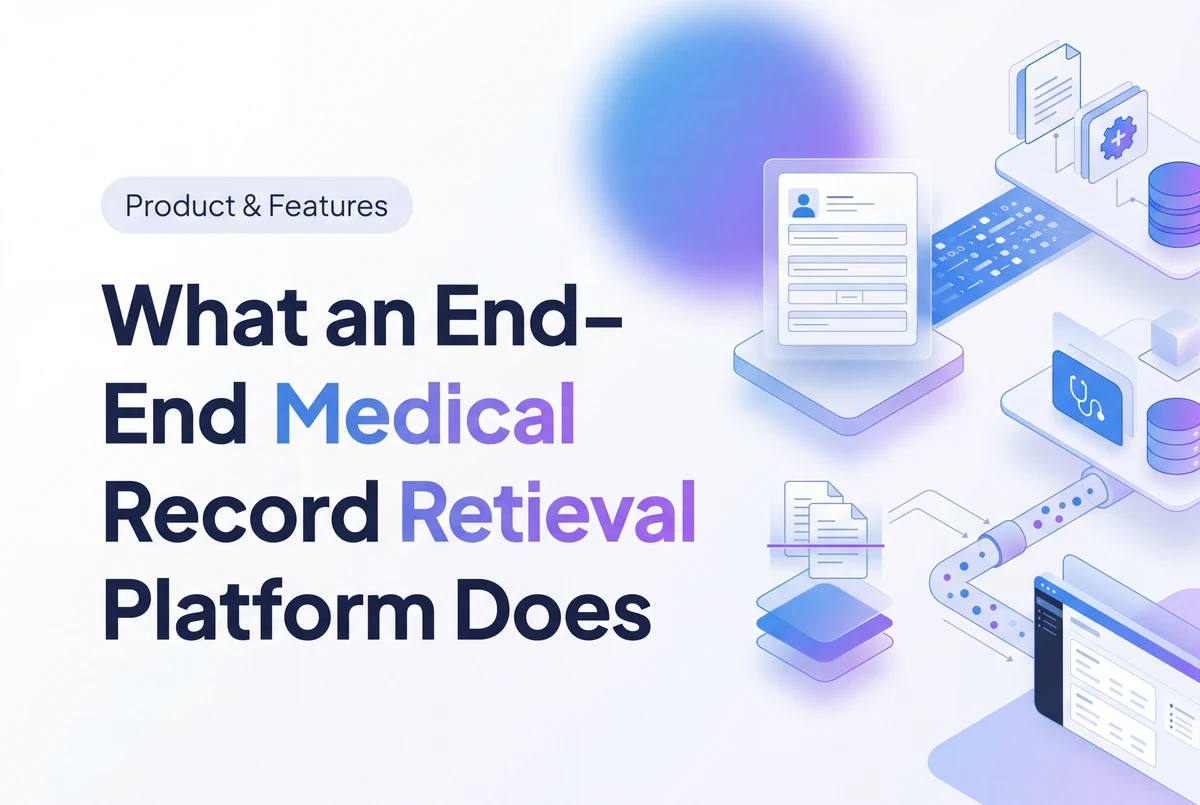
Most personal injury firms run their medical records workflow across four or five separate vendors: one for authorization forms, another for retrieval, a third for OCR, a fourth for analysis or chronologies, and an intake tool that holds the case data. Each handoff loses fidelity, each invoice is structured differently, and only some of those costs end up recoverable as case expenses on the settlement statement. An end-to-end platform collapses all of that into one pipeline: authorize, identify, retrieve, analyze, and build referrals, running on a single per-case invoice that flows through to the settlement.
The shift matters because the three biggest pain points PI firms face on records all live at the seams between tools: speed losses during handoffs, paralegal headcount built around manual coordination, and overhead costs that never make it back from the settlement. End-to-end retrieval platforms address all three at once. Paralegals spend an average of 31% of their time on record retrieval and follow-up, with most of that time spent on workflow stitching rather than retrieval itself.
Turnaround time for full records, with ~30-40% returned same-day on electronic requests
Retrieval paralegals replaced by 1 coordinator + platform in a typical mid-size firm
Of platform retrieval costs recoverable as case expenses from settlements (Nolo)
The five stages of end-to-end retrieval
Every modern retrieval platform owns the same five-stage pipeline. The difference between a stitched vendor stack and an end-to-end platform is whether data passes through all five stages in one system or gets re-entered, re-formatted, and re-invoiced at every handoff.
1. Authorize
Generate HIPAA-compliant authorizations, validate against state-specific rules, and pre-check every form for the issues that cause provider rejection.
2. Identify
Reverse search uses insurance data to fill in treatment gaps clients don't always remember, surfacing facilities, dates, and clinicians as needed.
3. Retrieve
Submit to the right department at the right facility, automatically follow up, and deliver records in 4 days on average instead of 30-60 days.
4. Analyze
Convert raw PDFs into structured chronologies, clinical summaries, and itemized billing so records arrive ready for demand prep.
5. Build Referrals
Query the entire caseload in plain English to find existing clients who qualify for new mass torts and referral opportunities.
Stage 1: Authorize
Authorization is the most common point of failure in the records workflow. State requirements differ: some states require specific language for substance abuse records, some require fresh signatures within 60 days, and some require explicit listing of every provider name. Industry-wide, authorization rejection rates run 15% to 25%, and every rejection adds 2 to 3 weeks to retrieval time as the firm corrects the form and resubmits.
A platform-level authorization layer generates state-compliant forms automatically, validates patient and provider details against destination facility requirements, and pre-checks every signature and date before submission. The rejection rate drops under 2%, preventing cases from stalling on paperwork issues.
Stage 2: Identify
Clients do not always remember every treatment location following an injury. For a typical PI case requiring records from six to eight providers, secondary treatment sources often go unmentioned during intake. Those forgotten providers, such as urgent care clinics, imaging centers, physical therapy offices, and specialists seen once, often hold the documentation that substantiates causation and injury severity.
Provider discovery automates the investigation that used to require staff calling pharmacies and combing through EOBs. Reverse search uses insurance data to fill in treatment gaps clients don't always remember, surfacing facilities, dates, and clinicians as needed.
Stage 3: Retrieve
The retrieval stage determines overall case velocity. Traditional retrieval relying on manual faxes, phone follow-ups, and spreadsheets averages 30 to 60 days per provider. An end-to-end platform delivers in 4 days on average by submitting electronically where possible, routing fax requests to the correct HIM department on the first attempt, and escalating non-responders automatically. About 30-40% of electronic and portal requests are returned same day.
Speed at this stage matters because downstream tasks depend on it. Case analysis cannot begin until records arrive, demand prep cannot start until analysis is complete, and settlement negotiations cannot open until demand packets are delivered. Compressing retrieval accelerates the entire downstream timeline.
Stage 4: Analyze
Unindexed 800-page scanned PDFs create significant review bottlenecks, often requiring eight or more paralegal hours per case. The analysis stage converts raw documents into structured, searchable data: clinical chronologies, deduplicated visit timelines, extracted medications and diagnoses, and itemized billing tables.
When analysis is integrated directly into the retrieval platform, data carries over with intact patient IDs, case metadata, and page citations. The result is demand-ready evidence upon delivery.
Stage 5: Build referrals
Once records are structured and searchable across an entire active and archived docket, a firm can run portfolio-level queries across its client base.
A natural-language query like "Ozempic users with documented gastroparesis" or "hair relaxer users with uterine cancer diagnoses" surfaces existing clients who qualify for emerging mass torts. Cases the firm previously resolved or closed can be evaluated for new litigation. Records the firm already retrieved become an ongoing source of referral revenue.
Why end-to-end platforms outperform fragmented vendor stacks
Fragmented vendor stacks introduce handoff friction: five separate vendors mean five separate invoices, five data formats, and multiple points where authorizations or provider details can fall out of sync.
Stitched Vendor Stack vs End-to-End Platform
Stitched Vendor Stack
Data Re-Entered at Every Handoff
Patient and case data re-keyed across authorization, retrieval, OCR, and analysis tools with fidelity loss at each step
Mixed Recoverable and Overhead Costs
Some invoices flow through as case expenses while others are classified as platform fees the firm absorbs as overhead
No Cross-Case Visibility
Records sit in separate systems without the ability to query the full caseload for patterns or referral opportunities
End-to-End Platform
Single Pipeline, No Handoffs
Patient and case data flows through all five stages in one system with unified metadata end to end
Single Per-Case Invoice
One per-case invoice that flows directly to the settlement statement as a recoverable case expense
Caseload-Wide Analytics
Query every record across every case in plain English to identify mass tort opportunities from existing clients
Core operational benefits for personal injury firms
1. Speed compresses case cycles and cash flow
Faster records enable earlier case evaluations, faster demand letters, and quicker settlements. Across hundreds of active matters, accelerating record delivery by two to three weeks compresses the firm's revenue cycle. Cases that once waited 60 days for records become demand-ready in the first week, improving cash flow and reducing working capital tied up in active files.
2. Headcount shifts to higher-value legal work
A mid-size personal injury practice handling 25 new cases per month with 8 providers per case processes over 200 record requests monthly. Managing that volume manually often requires 10 retrieval paralegals. With an end-to-end platform, one coordinator can manage the workflow while other staff focus on client intake, demand preparation, and litigation support.
3. Costs shift from firm overhead to recoverable case expenses
Paralegal salaries are firm overhead that cannot be charged to clients. Vendor invoices for record retrieval are case expenses advanced by the firm and recovered from settlement proceeds before calculating contingency fees. Shifting from in-house retrieval to an outsourced platform moves expenses off the overhead ledger and onto the case-expense ledger where settlements reimburse them.
The Platform Fee Trap
Turning case records into referral pipelines
Structuring and deduplicating records across an entire docket creates a searchable database of client medical histories.
When new mass tort litigations emerge, the firm can query its existing caseload in plain English to identify qualifying clients without spending additional marketing capital. Files already retrieved serve as an ongoing asset for practice growth.
The firms that lead the market will be those whose records workflows also support ongoing client opportunities. End-to-end retrieval makes that possible by keeping all medical records structured in a single queryable system.
Shere SaidonCEO & Founder, LlamaLab
Key Points
Essential takeaways from this article
Platform impact
An end-to-end medical record retrieval platform delivers records, structures clinical data, and enables portfolio-wide search to support casework and referral discovery. The operational gains, including shorter case cycles, reduced administrative overhead, and fully recoverable case expenses, follow directly from running the pipeline inside a single system.
Get the End-to-End Retrieval Playbook (PDF)
The PDF guide covers pipeline architecture diagrams, vendor evaluation scorecards, and fee agreement language to support clean cost recovery.
- Five-stage pipeline diagram for internal operational planning
- Vendor evaluation scorecard with 12 criteria for assessing platforms
- Sample fee agreement clauses for classifying retrieval as a recoverable case expense
Free PDF, no commitment
See What End-to-End Looks Like on Your Caseload: Free
LlamaLab offers a no-commitment evaluation. We map your current retrieval vendor stack, calculate fully loaded costs, and show how consolidating retrieval and analysis on one platform shifts expenses to a single recoverable invoice.
Sources: Nolo: Case Costs in Personal Injury, AllLaw: Managing PI Case Expenses, ChartRequest: Retrieval Challenges, Clio Legal Trends Report. Internal data based on LlamaLab retrieval volume processed in 2025-2026.
Stay Updated with Latest Insights
Get the latest articles about medical record retrieval and legal tech delivered to your inbox.