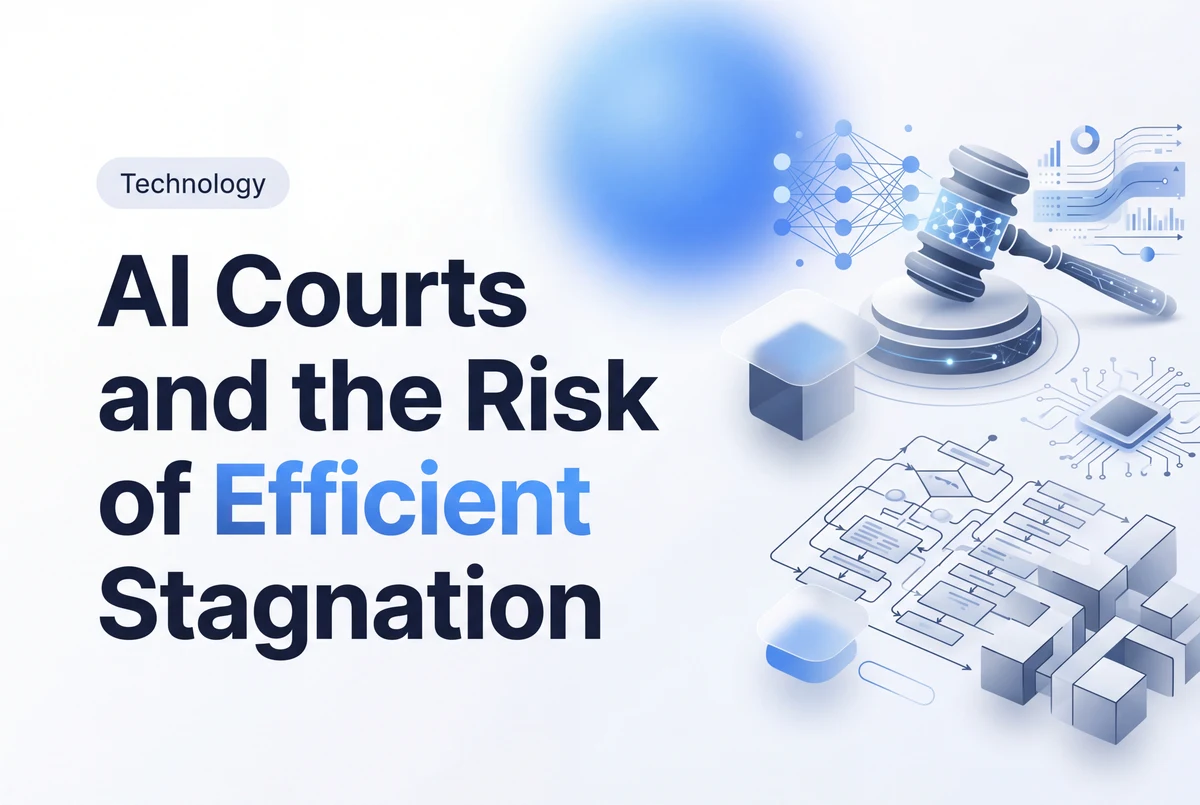
AI Courts and the Risk of Efficient Stagnation

CEO & Founder at LlamaLab
AI Courts and the Risk of Efficient Stagnation
How ironic would it be if we murdered societal progress in the name of efficiency?
That is the question I kept coming back to after reading Chief Justice Stephen Gageler's recent comments on AI and judging. In a speech on Australia's constitutional and judicial system, Gageler said something most people in law are still afraid to say plainly: AI may become more predictable, more learned, and in many cases fairer than human judges. He went further in the Q&A, saying he fears "there is very little that the judge does that AI cannot do better." That is a big statement from a sitting Chief Justice.
But the part that interests me is not whether AI can summarize records, find cases, or produce cleaner logic than a tired human working through a crushing docket. Of course it can. The harder question is what happens when the system is designed to learn from the past.
Key Points
Essential takeaways from this article
The Problem With Perfect Consistency
Law depends on precedent. That is not a bug, it is part of how courts create stability. People need to know that similar facts will be treated in similar ways. Lawyers need rules they can rely on. Judges need a shared body of reasoning that keeps each case from becoming a personal opinion exercise.
But precedent is not sacred because it is old. It is useful because it gives the law continuity while society changes around it. The tension is the whole point. Courts are not only machines for applying what happened before, they are also one of the places where society decides when the old frame no longer works.
That is where AI gets interesting. If a judicial AI system is trained around past decisions, prior outcomes, and institutional consistency, it may get very good at reproducing what courts have already done. Maybe it becomes more consistent than human judges, maybe it catches facts humans miss, maybe it reduces delay for civil disputes, traffic violations, divorce proceedings, benefits decisions, and other high-volume areas where people are often stuck inside slow systems they barely understand. That would be real progress.
But it could also be a cleaner way to freeze the law in place.
Past Decisions Carry Past Assumptions
Every dataset has a worldview. In law, that worldview is precedent, prior filings, judicial language, procedural habits, settlement norms, enforcement patterns, and institutional memory. Some of that is valuable. Some of it is the record of how power worked at the time.
Systems trained on the past do not only learn rules, they learn weight. They learn which facts courts historically cared about, which harms were easy to recognize, which people were believed, and which claims sounded ordinary instead of disruptive. If the model is built to maximize consistency with prior decisions, then the system may treat inherited bias as legal wisdom. It may not look biased. It may look disciplined.
That is what makes it dangerous.
The design risk
Original Thought Is a Design Problem
People talk about AI as if the model is the whole product. It is not. The model matters, but the orchestration matters more. What data gets weighted? Which sources are treated as authority? What gets excluded? When does the system defer to precedent, and when does it flag that precedent may be doing too much work?
This is where "AI in courts" becomes a bigger question than courts. The same design problem appears anywhere AI is used to support decisions about people: insurance claims, employment screening, credit decisions, school discipline, immigration review, fraud detection, benefits eligibility. If the system learns from historical decisions without challenging their assumptions, it can preserve the exact patterns we claim to be improving.
The goal cannot be parroting the archive faster, it has to be reasoning with the archive without becoming trapped by it. That is hard because LLMs are very good at producing plausible continuity. They are pattern machines that can make yesterday's reasoning sound clean, neutral, and inevitable. Original thought does not come from a model magically deciding to be brave. It has to be designed into the workflow.
What Better Design Looks Like
I do not think the answer is pretending courts should avoid AI. That is not serious. Judicial systems are overloaded. Civil disputes can take too long. People with money and counsel can survive delay better than people without either. If AI can reduce procedural drag, summarize huge records, find relevant authority, and help judges see the full picture faster, courts should study that carefully.
But speed cannot be the only metric. Here are the questions I would want answered before any judicial AI system gets near decision support:
-
What is the system optimizing for? Faster disposition is not the same as better justice. Consistency is not the same as fairness. Predictability is not the same as legitimacy.
-
How are past decisions weighted? A precedent should not be treated the same way as a pattern. A binding principle should not be treated the same way as a historical habit.
-
Can the system surface stale assumptions? If an output relies heavily on older reasoning, contested doctrine, or patterns later criticized by courts or legislatures, the system should make that visible.
-
Where does human review become mandatory? The human role should not be rubber-stamping fluent output. It should be judgment: deciding whether the frame is right, whether the facts are being understood, and whether the result deserves institutional force.
-
Can the AI argue against its own conclusion? A system that only produces the most likely answer is not enough. It should be able to produce the strongest reason the likely answer might be wrong.
That last point matters most.
Original reasoning often starts as friction. A fact that does not fit. A precedent that feels misapplied. A social reality the old doctrine did not anticipate. If the AI is designed to smooth out friction, it may smooth out the very thing justice needs.
The Question Is Not Whether AI Can Judge
Chief Justice Gageler is right to force the uncomfortable conversation. AI will handle significant judicial support work better than humans. It can summarize more, compare more, remember more, and produce more consistent drafts of legal reasoning than many people want to admit. But that is only the starting point.
If courts build judicial AI around efficiency alone, the result is systems that move faster while thinking less critically. Systems that look fair because they are consistent, and consistent because they were trained on a past full of inequities, do not improve justice. Speed without scrutiny does not fix the past; it reproduces inherited patterns more efficiently.
The objective is not to make AI seem human. It is to prevent AI from blindly automating history. The real question is whether we are adopting AI to make courts faster, or to make justice better.
Stay Updated with Latest Insights
Get the latest articles about medical record retrieval and legal tech delivered to your inbox.