Legal AI Adoption Doubles to 69% in 2026

CEO & Founder at LlamaLab
Legal AI Adoption Doubles as Law Firms Lag Behind Individual Lawyers
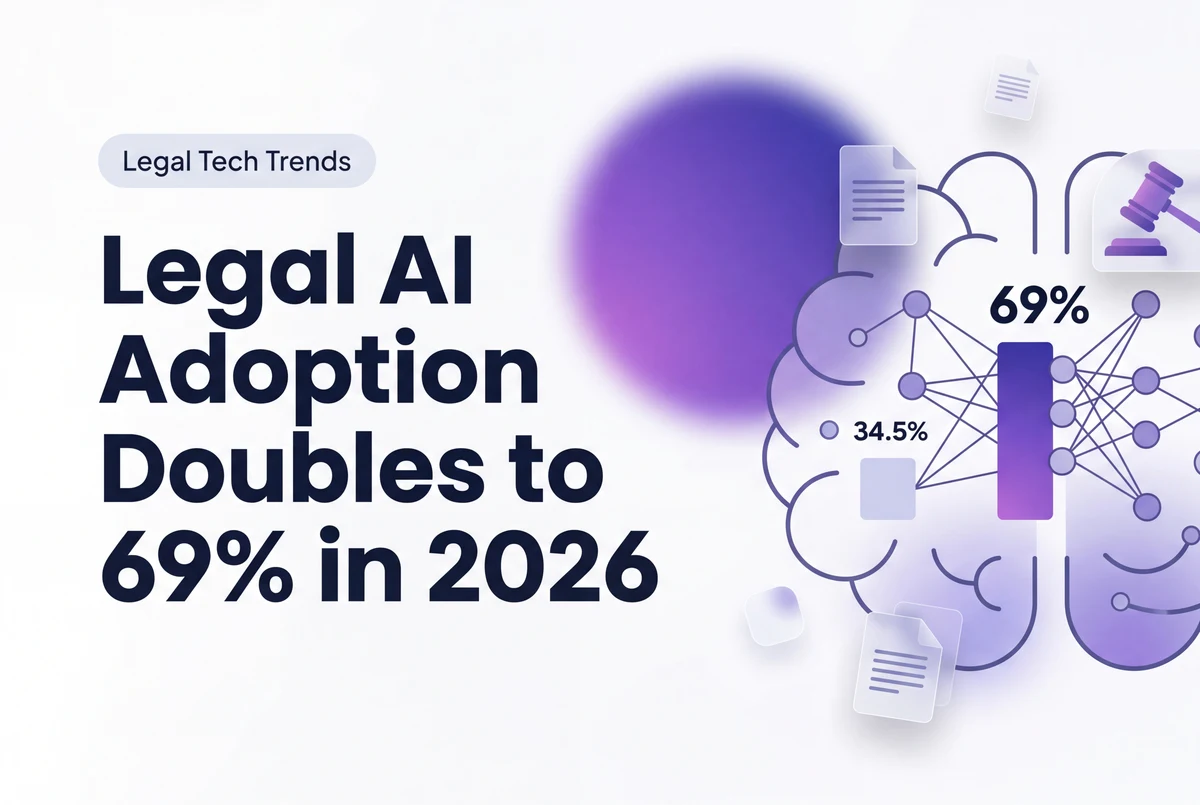
Nearly 69% of legal professionals now use general-purpose AI tools for work, more than doubling from 31% just one year ago, according to the 8am 2026 Legal Industry Report published March 5. Legal-specific AI tool usage doubled to 42%. But firm-level adoption tells a different story: only 34% of firms have formally adopted AI, and 43% have no AI policy and no plans to create one.
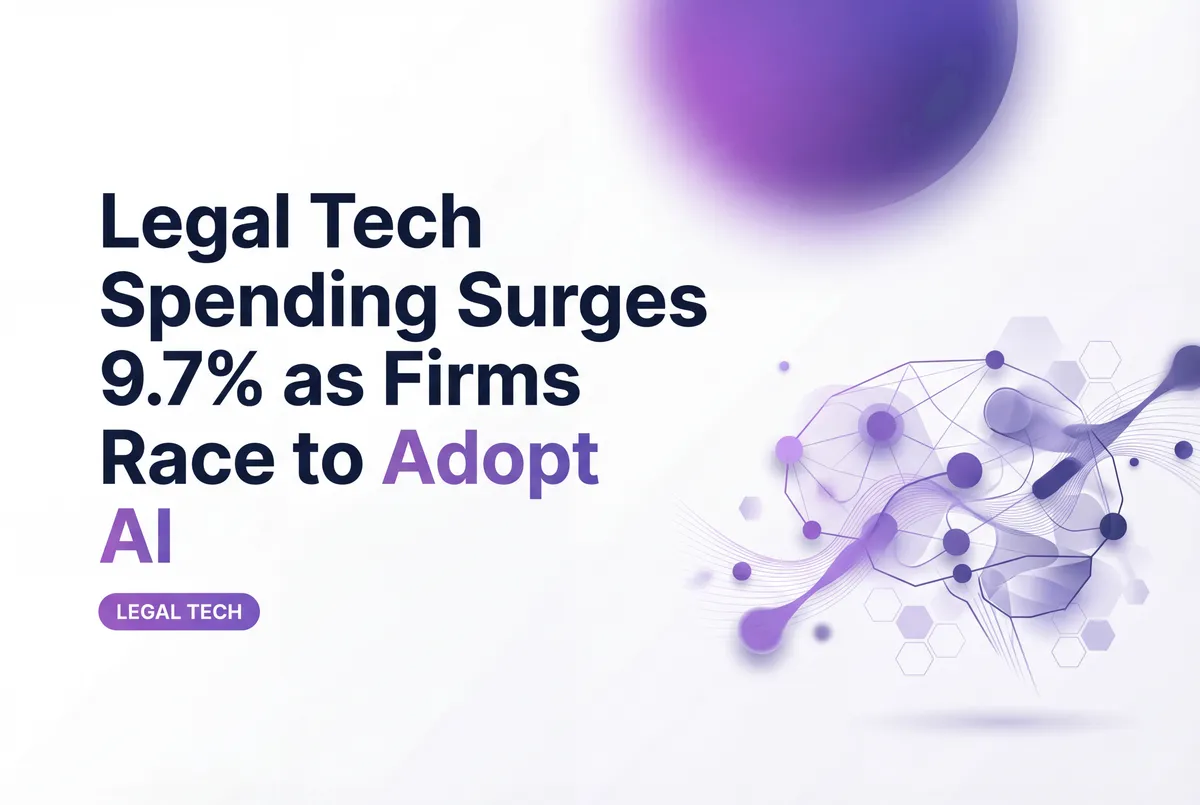
The gap between individual use and institutional readiness is the defining tension in legal technology heading into the second half of 2026. Thomson Reuters' State of the U.S. Legal Market report found that legal tech spending surged 9.7% in 2025, the fastest real growth likely ever recorded in the legal industry, yet 85% of law firms either don't collect ROI data on AI or are unsure whether they do.
Of legal professionals now use AI, doubled from 31% in 2025 (8am Report)
Of firms have formally adopted AI, leaving a 35-point governance gap (8am Report)
Of AI users report measurable productivity benefits (8am Report)
What the Data Shows
The 8am report, based on a survey of 1,300+ legal professionals conducted in fall 2025, found that AI has moved from experimentation to daily workflow. Twenty-eight percent of respondents use AI daily, another 31% use it several times a week, and only 19% report never using AI at all.
The productivity gains are concrete: 38% save 1 to 5 hours per week, 14% save 6-10 hours, and 5% save 11-15 hours. Only 6% report no productivity gains, down from 16% the prior year. The top use cases for legal-specific AI are legal research (58%), document drafting (49%), and document summarization (47%).
"Instead of taking decades to reach the majority of legal practitioners, it's taken three years," the report noted.
The Investment Signal
The Governance Gap
The headline adoption number obscures a structural problem. While 69% of individuals use AI, only 34% of firms have formally adopted it. The gap exists because most firms have no one accountable for AI governance.
Forty-three percent of firms have no formal AI policy and no plans to create one. Only 9% have a written, actively enforced policy. Fifty-four percent provide zero AI training, and only 11% mandate training for all staff. The result is what the industry calls "shadow AI", lawyers using unapproved tools without guardrails, creating security and privilege risks that firms don't even know exist.
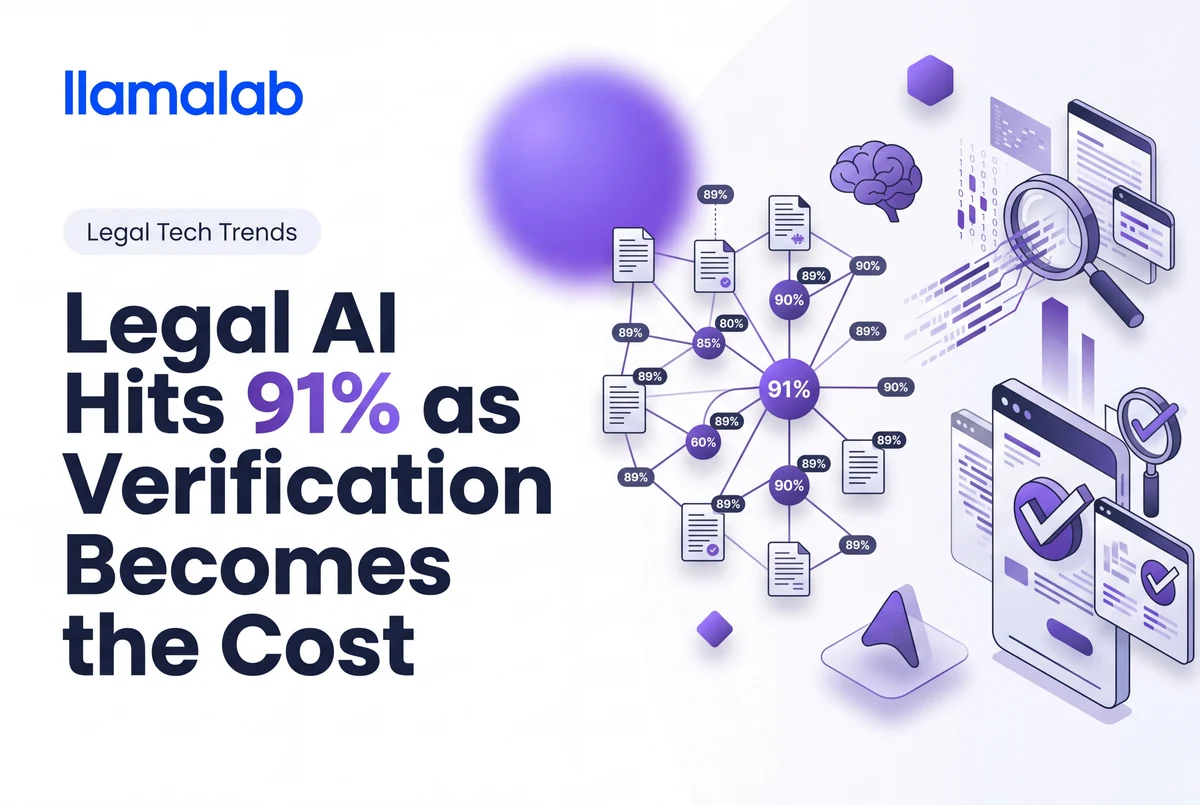
The concerns are not theoretical. Data security (46%), ethical issues (42%), and privilege concerns (39%) are the top barriers to institutional adoption. A 2025 mid-sized firm breach revealed settlement terms through ChatGPT logs, and 60% of general counsels say they would switch firms after a single confidentiality lapse.
Traditional Approach vs LlamaLab Solution
Traditional Approach
Shadow AI Usage
59% of employees use unapproved AI tools; 75% share sensitive data with them
No Governance Framework
43% of firms have no AI policy and no plans to create one
Zero Training
54% of firms provide no AI training to staff
Hidden & Unpredictable Costs
Per-page fees, rush charges, and surprise bills that blow up your budget
LlamaLab Solution
Purpose-Built Legal AI
HIPAA-compliant, SOC 2 certified tools designed for sensitive medical and legal data
Embedded in Workflow
AI integrated into existing case management systems, no shadow tools needed
Domain-Specific Intelligence
Trained on medical and legal documents, not general internet data
Flat Transparent, Risk-free Pricing
1 flat fee covers all costs. Only pay full price for cases that authorize
Where PI Firms Are Leading
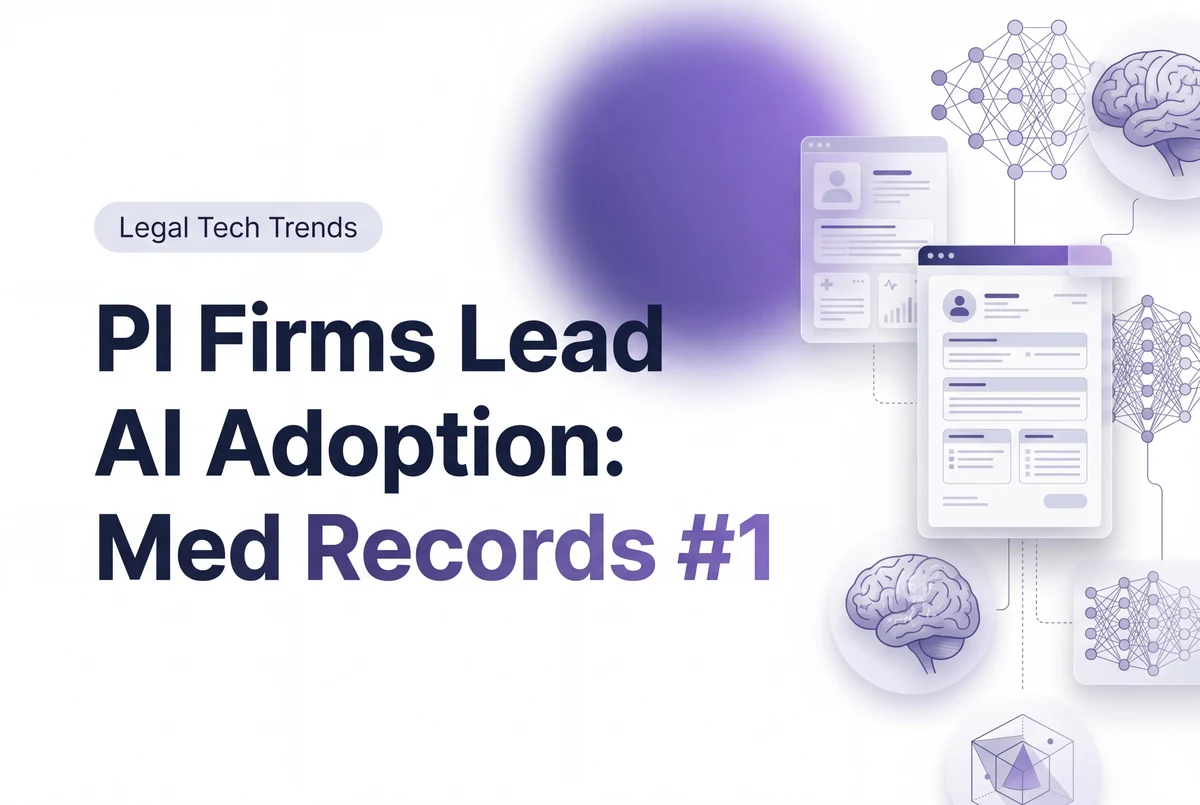
Personal injury firms are outpacing the broader legal industry in AI adoption. AffiniPay's 2025 data found 37% of PI professionals use generative AI individually, above the 31% industry average at the time, and 63% of PI firms report using at least one AI-powered tool.
The use case driving adoption is clear: 56% of PI firms ranked summarizing and analyzing medical records as their number one AI need, according to CASEpeer's 2026 trends data. AI-powered medical record review reduces analysis time by 60-90%, compressing what previously took 5+ hours per case to under 2 hours.
The revenue correlation is striking. Firms deploying AI broadly are approximately 3x more likely to report revenue growth than non-adopters. Thomson Reuters estimates AI could unlock $300,000 in new billable time per lawyer annually, and a Forrester TEI study found $626,000 in increased productivity over three years for a 20-person legal team.
The Regulatory Backdrop
The governance gap isn't just a business risk, it's an ethical one. 47 states now have formal AI ethics guidance as of February 2026, and the ABA's Formal Opinion 512 (July 2024) established six core obligations for lawyers using AI: competence, confidentiality, communication, fees, candor, and supervision. All require human verification of AI output before filing.
For firms handling medical records, which carry HIPAA obligations on top of ethical duties, the distinction between purpose-built legal AI and general-purpose tools is not academic. HIPAA penalties reach up to $50,000 per violation for healthcare-related data shared with unapproved platforms.
Key Points
Essential takeaways from this article
The Bottom Line
The 8am report confirms what the investment data has been signaling: AI in legal is no longer experimental. Nearly seven in ten legal professionals use it, the productivity gains are measurable, and the firms that adopt strategically are seeing revenue growth at 3x the rate of non-adopters.
But the 35-point gap between individual use and firm adoption is unsustainable. Lawyers are already using AI, the question is whether firms will govern it or let it govern itself. For PI firms in particular, where medical record analysis is the top AI use case, the choice between purpose-built tools with HIPAA compliance and unvetted general-purpose platforms is the most consequential technology decision of 2026.
AI-Powered Medical Record Analysis, Built for Law Firms
LlamaLab delivers HIPAA-compliant medical record retrieval in 4 days on average, with clinical analysis built for personal injury and mass tort litigation.
Sources: 8am 2026 Legal Industry Report, LawNext Analysis, Thomson Reuters 2026 State of the Legal Market, CASEpeer 2026 PI Trends, DocuLex AI in PI Analysis. Survey data from 1,300+ legal professionals surveyed September-October 2025.
Stay Updated with Latest Insights
Get the latest articles about medical record retrieval and legal tech delivered to your inbox.