
Guides & Resources
7 min read
Why Hospitals Are So Slow to Release Medical Records
Hospitals can legally take 30 days plus a 30-day extension, and enforcement is rare: 54 OCR actions since 2019 against roughly 31,000 complaints a year.
Read
The complete guide to medical record retrieval in legal practice, from HIPAA authorizations and state fee schedules to retrieval speed and provider discovery.
Medical records are the evidentiary foundation of nearly every personal injury, medical malpractice, and mass tort case. They establish causation, document treatment timelines, quantify damages, and ultimately determine case value. Yet for most law firms, obtaining those records remains one of the most frustrating bottlenecks in litigation: long wait times, unpredictable costs, and fragmented provider networks.
This guide covers the full landscape of medical record retrieval in legal practice: how the process works, where it breaks down, and what firms can do to get records faster and more reliably.
Every claim involving bodily injury depends on medical documentation. Without complete records, attorneys cannot establish the severity of injuries, link treatment to a specific incident, or calculate economic damages. Insurance adjusters and defense counsel routinely challenge cases where the medical record is incomplete or inconsistent.
Beyond the individual case, medical records drive firm-level economics. The faster a firm builds a complete medical file, the sooner it can evaluate a case, issue a demand, and move toward resolution. Delays in retrieval directly translate to delays in revenue. For a deeper look at how the retrieval process fits into broader case preparation, see our overview of medical records management.
The conventional process for obtaining medical records has not changed much in decades. A paralegal identifies known providers, drafts authorization forms, mails or faxes requests, and then waits. Response times vary wildly. Some providers respond in a week, others take 60 days or more. Records arrive in different formats, often as scanned PDFs with inconsistent page ordering and no index.
The friction compounds across a case with multiple providers. A personal injury plaintiff who visited an emergency room, an orthopedic surgeon, a physical therapist, and a primary care physician requires four separate requests, each with its own timeline and fee structure. Multiply that across a caseload of hundreds, and the operational burden becomes a significant drag on firm productivity. Our guide to streamlining the request process outlines where the most common breakdowns occur and how to address them.
One of the most consequential decisions in retrieval is choosing the right legal mechanism to obtain records. The two primary instruments, HIPAA authorizations and subpoenas, serve fundamentally different purposes and operate on different timelines.
A HIPAA authorization is a voluntary consent signed by the patient (your client) permitting a covered entity to release protected health information. It is governed by 45 CFR 164.508 and typically takes 30 to 45 days for providers to process. Authorizations work well for obtaining your own client's records from cooperative providers.
A subpoena, by contrast, is a legal order that compels disclosure under 45 CFR 164.512(e). Subpoenas generally produce faster responses (7 to 14 days in most jurisdictions) and are necessary when seeking records from opposing parties, non-responsive providers, or during formal discovery. However, they require proper notice to the patient and must meet jurisdiction-specific procedural requirements.
Choosing the wrong method can cost weeks. Using an authorization when a subpoena is warranted means waiting longer than necessary. Filing a defective subpoena can result in a motion to quash and further delays. For a detailed breakdown of when to use each approach, including common mistakes that get requests rejected, read our analysis of subpoena vs. HIPAA authorization.
A widespread misconception among attorneys is that HIPAA caps all medical record fees at $6.50 per request. That figure applies only to patient-directed requests for electronic copies under the 2016 HHS guidance. Attorney-initiated requests, whether by authorization or subpoena, are governed by state law, and the variation is substantial.
Per-page fees range from $0.25 in California to over $1.00 in Florida, Ohio, and Pennsylvania. Many states also allow providers to charge separate search fees, certification fees, and rush processing surcharges. For a firm handling a PI case requiring records from six to eight providers, total per-case retrieval costs routinely exceed $800.
The state-by-state variation makes cost forecasting difficult, particularly for firms operating across multiple jurisdictions. Our 2026 state fee schedule guide covers the specific fee structures in every state, including recent legislative updates and common overcharges to watch for.
Retrieval timelines are one of the most unpredictable variables in case management. HIPAA does not impose a specific deadline on providers for responding to authorization-based requests, and state laws vary. Some jurisdictions require a response within 30 days; others allow up to 60. In practice, response times depend on the provider's size, staffing, and release-of-information processes.
For attorneys managing litigation deadlines, these timelines create real problems. A discovery cutoff or settlement conference does not move because a hospital's medical records department is backlogged. Understanding realistic timelines, and planning retrieval strategy around them, is essential to avoiding last-minute scrambles. Our timeline guide for lawsuits provides a detailed breakdown of expected turnaround times by provider type, request method, and jurisdiction. For national timing data, see our 2026 retrieval speed benchmarks.
One of the most overlooked challenges in medical record retrieval is simply identifying all of the providers who treated a client. Patients frequently underreport their treatment history. They forget about the urgent care visit the day after an accident, the specialist referral they saw once, or the telehealth appointment during recovery.
Missing even a single provider can leave gaps in the medical narrative, gaps that opposing counsel will exploit. Provider discovery is the process of systematically identifying every healthcare provider who treated a client, including those the client may not recall. This involves cross-referencing insurance claims data, pharmacy records, referral patterns, and billing histories to build a comprehensive provider list before requesting records.
For firms handling cases where treatment spans years or involves multiple specialists, provider discovery is not optional. It is foundational. Our deep dive on provider discovery explains the methodology and why firms that skip this step routinely leave evidence on the table.
Medical record retrieval is a significant expense line item for litigation practices. The question of whether and how to recover those costs from case proceeds is both a financial and ethical consideration that varies by jurisdiction and fee arrangement.
In many contingency fee arrangements, retrieval costs are advanced by the firm and recovered from the settlement or judgment. The recoverability of specific costs (per-page fees, service fees, rush charges) depends on the retainer agreement, local rules, and how costs are documented. Firms that do not track retrieval expenses at the case level often leave recoverable costs on the table.
For the ethics and billing rules firms actually use, start with our cost recovery guide for lawyers. For a narrower look at which line items are recoverable, see our guide to medical record cost recoverability. For a real-world example of how systematic cost tracking can produce significant returns, read our case study on recovering $700K in retrieval costs.
The direct costs of medical record retrieval (provider fees, per-page charges, service vendor invoices) are visible on a balance sheet. But the larger expense is often invisible: the paralegal hours spent on follow-up calls, the attorney time consumed by incomplete records, the settlement delays caused by missing documentation, and the case value lost when key evidence is never retrieved.
Studies show that law firms managing requests in-house spend an average of $144 per request, with $76 of that going to labor costs alone. For a firm processing thousands of requests per year, the labor component alone can exceed six figures annually. Our analysis of hidden retrieval costs breaks down where these expenses accumulate and how firms can quantify their true cost of retrieval.
Obtaining medical records is only half the challenge. Records must also be authenticated and presented in a form that meets evidentiary standards. Courts require that medical records be properly certified, that chain of custody is documented, and that the records have not been altered or selectively produced.
Authentication requirements vary by jurisdiction. Some courts accept a custodian of records affidavit; others require live testimony. Electronic records introduce additional considerations around metadata integrity, audit trails, and format conversion. Firms that treat retrieval as purely a logistics problem, without considering downstream admissibility, risk having critical evidence excluded at trial.
Our guide to evidence authentication and admissibility covers the specific requirements attorneys need to meet, common authentication failures, and best practices for maintaining evidentiary integrity from retrieval through trial.
Many firms eventually conclude that managing medical record retrieval in-house is not sustainable at scale. The question then becomes how to evaluate third-party retrieval services. Not all providers are equal, and the wrong partner can introduce new problems: opaque pricing, slow turnaround, lost requests, or poor communication.
Key evaluation criteria include turnaround time guarantees, pricing transparency (flat-rate vs. per-page), provider network coverage, technology capabilities (portal access, status tracking), HIPAA compliance documentation, and the ability to handle both authorization-based and subpoena-based requests. Firms should also consider whether a service offers value-added capabilities like provider discovery, record indexing, and cost auditing.
For a structured framework for evaluating retrieval partners, see our 2026 guide to choosing a medical record retrieval partner.
Records come back in 4 days on average, and 30 to 40% come back the same day.
Same-day is a share, not a guarantee. In some states the same-day share is closer to 60%, and some states and facilities average about 24 hours.
That speed changes case economics. Instead of waiting 30 to 60 days to evaluate whether a case has merit, firms can build a medical file in the first week of intake.
To see how the same-day share works in practice, read our breakdown of LlamaLab retrieval speed. For national timing data, see our 2026 retrieval speed benchmarks. For a broader perspective on where the industry is heading, see The Fastest Path to Medical Evidence.
Deep dives and guides on medical record retrieval for law firms
Hospitals can legally take 30 days plus a 30-day extension, and enforcement is rare: 54 OCR actions since 2019 against roughly 31,000 complaints a year.

Records come back in 4 days on average, and 30 to 40% come back the same day. Same-day is a share, not a guarantee, and some states run faster.

What personal injury and mass tort firms should expect in 2026: 30 to 60 days in-house, 4 days on average with a modern retrieval service.
HIPAA gives providers 30 days, but expedited services deliver in 3-7. Here's every timeline attorneys need to know.
The complete 50-state guide to medical record copy fees for attorneys. HIPAA's $6.50 cap doesn't apply to your requests. State fees range from $0.25 to over $1.50 per page, plus search fees, certification costs, and rush charges.
Authorization takes 30-45 days. Subpoenas compel responses in 7-14. When to use each method, and mistakes that get requests rejected.

Clients do not always recall every treating facility. How reverse provider search cross-references insurance and prescription data to uncover complete medical records.
How PI and litigation firms recover medical record retrieval as a case disbursement, and why staff time and software seats do not qualify.

How to properly document, allocate, and recover medical record expenses in litigation, maximizing case value while maintaining ethical compliance.

In-house paralegals are overhead. Outsourced retrieval is a recoverable case expense. Here's the math on why this shift saves firms $700K+.
How staff hours, case delays, and unrecovered disbursements impact law firm profitability, and how to structure retrieval as a recoverable case expense.

How to request and receive complete medical records through LlamaLab, with 4-day average turnaround, reverse provider search, and clinical indexing.

Avoid common vendor pitfalls that cost law firms time and money. What questions to ask, pricing red flags to watch for, and how to evaluate retrieval partners.

Rule 803(6) gets records into evidence, but authentication failures get them thrown out. The rules every litigator needs.

With retrieval delays averaging 45-90 days, law firms are turning to automated routing and reverse search to secure complete records in 4 days on average.
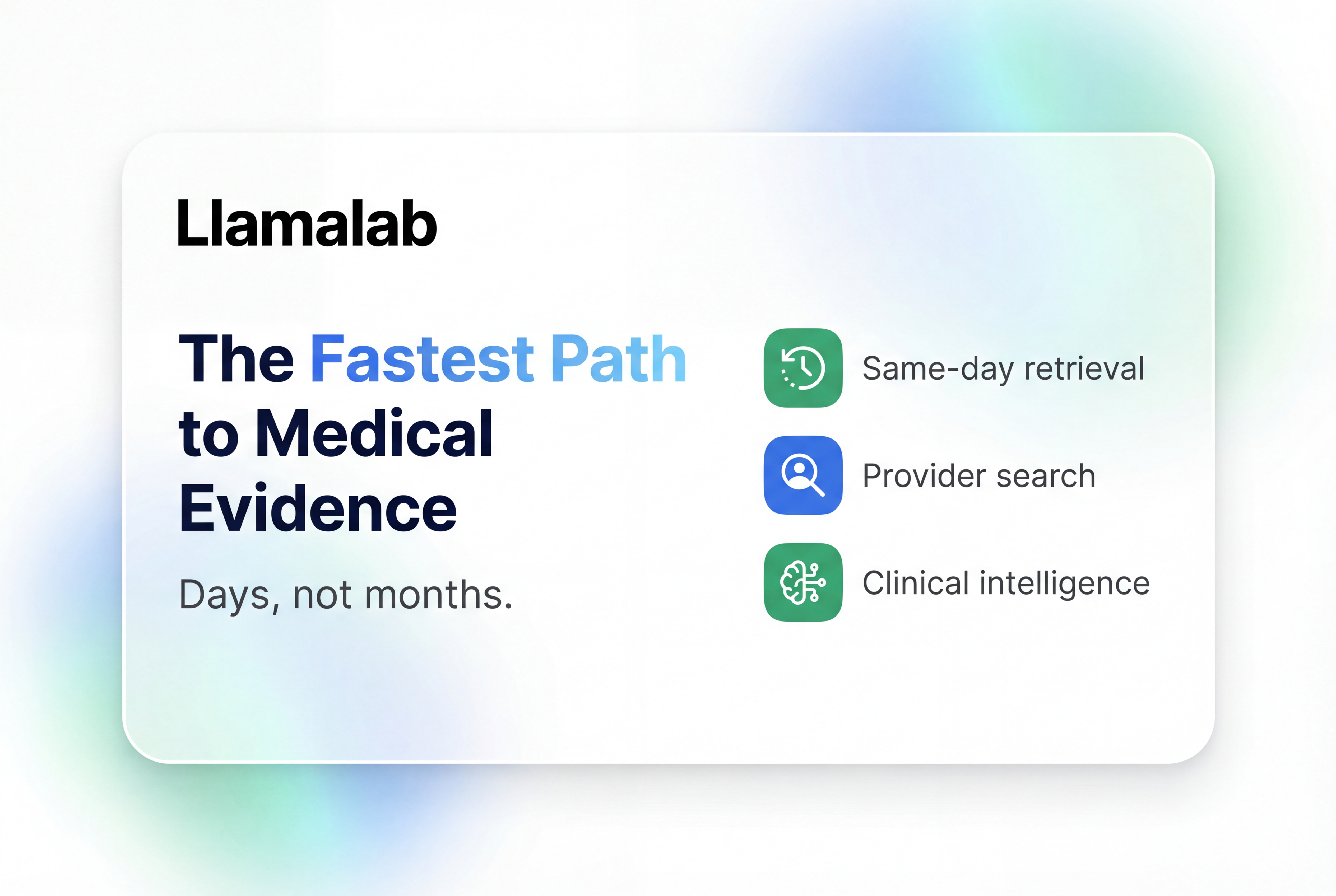
Automated retrieval delivers records in 4 days on average, with 30-40% returned same day, compared to the industry's 45-day average.

How effective medical records management strengthens legal cases, improves client outcomes, and streamlines law firm workflows.
HHS OCR's Concentra settlement highlights HIPAA's 30-day access deadline, fee limits, and what patients can do when providers delay medical records.
The Conduent data breach now affects 25M+ Americans: SSNs, medical records, and Medicaid data stolen across 30+ states.

OCR's $175K settlement with BST & Co. CPAs shows business associates: including law firms handling PHI: face the same Security Rule risk-analysis duties as providers.

The 50-state guide to how long hospitals and physicians must keep medical records, from no state mandate in Wyoming to 26 years in Washington.