Medical Record Costs as Recoverable Case Expenses: What Every Attorney Should Know

Enterprise Account Executive at LlamaLab
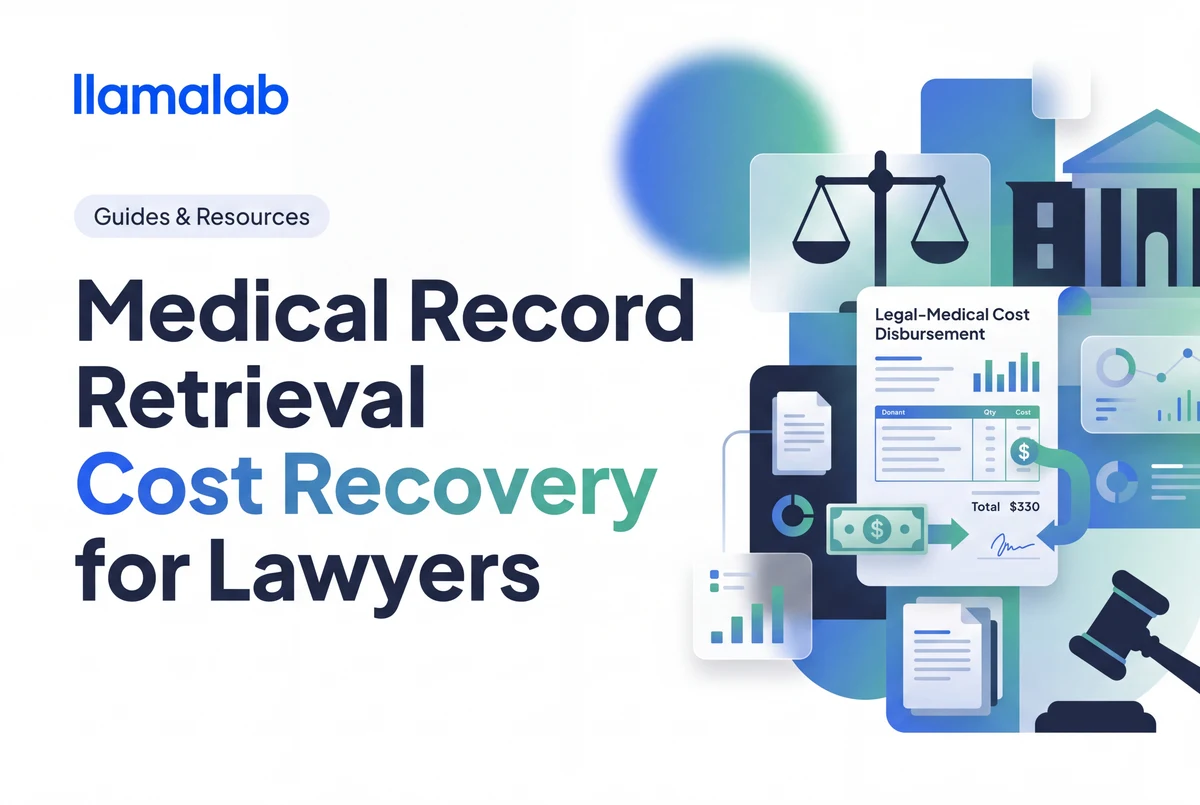
Medical records form the factual basis of personal injury and medical malpractice litigation. While obtaining these records requires upfront capital, third-party retrieval invoices are generally recoverable as case expenses. Understanding how courts and fee agreements treat these costs allows law firms to protect case profitability while remaining fully compliant with state ethics rules.
Recoverable case expenses
Courts across jurisdictions recognize medical records retrieval as a necessary litigation expense. When properly documented, these costs can be deducted from gross settlement proceeds before calculating the attorney contingency fee.
What qualifies as a recoverable expense?
Reasonable expenses directly associated with obtaining medical evidence qualify for recovery, including:
- Third-party record retrieval invoices
- Statutory copy charges assessed by healthcare providers
- Certification fees for official or custodian records
- Document processing and indexing fees tied to specific cases
- Itemized clinical summaries and billing extraction reports
I consider medical record costs recoverable. It creates efficiency in the process and ensures that necessary evidence is properly obtained.
Former State Court JudgeNortheastern Circuit
Legal framework for cost recovery
The foundation for cost recovery begins with the client retainer agreement. The agreement must clearly specify how case costs are handled: who advances litigation expenses, how reimbursement occurs upon settlement, and whether expense recovery depends on securing a financial recovery. Setting clear terms at intake prevents disputes at settlement distribution.
Statutes and procedural rules support this practice. Federal Rule of Civil Procedure 54(d) provides for the taxation of necessary costs to prevailing parties, while state civil procedure rules and local court guidelines routinely permit recovery of reasonable litigation disbursements.
In settlement negotiations, itemized medical record costs provide objective documentation of litigation investment. Presenting a clear accounting of all matter-specific disbursements substantiates case demands and ensures transparent accounting with clients.
Of court systems accept third-party medical record invoices as recoverable expenses
Average untracked medical record expenses per case in manual tracking workflows
Of attorneys report improved settlement accounting with itemized expense logs
Documentation standards for cost recovery
Successful cost recovery requires systematic record-keeping from initial intake:
- Matter-specific logging: For each request, record the date submitted, the destination provider, the clinical purpose, and the invoiced amount.
- Payment verification: Retain vendor receipts and proof of payment tied to the specific client file.
- Automated matter allocation: Use accounting or case management tools that automatically assign retrieval invoices to individual case ledgers.
- Client disclosure: Provide itemized disbursement summaries during case settlement reviews so clients see exact cost breakdowns.
Traditional Approach vs LlamaLab Solution
Traditional Approach
Basic Documentation
Simple receipts with minimal detail that create challenges during settlement accounting.
Manual Allocation
Time-consuming manual entry in general ledger accounts with risk of misallocated costs.
Limited Client Reporting
End-of-case expense summaries provided without itemized vendor receipts.
Unpredictable Charges
Variable per-page fees and unexpected administrative charges that complicate recovery.
Hidden & Unpredictable Costs
Per-page fees, rush charges, and surprise bills that blow up your budget
LlamaLab Solution
Complete Documentation
Itemized, matter-specific invoices that document retrieval costs for clean recovery.
Automated Tracking
Expenses automatically allocated directly to client matter ledgers upon delivery.
Transparent Reporting
Clear disbursement statements designed for client review and court submission.
Predictable Flat Fees
Flat-fee pricing structures that eliminate per-page surprises and simplify cost recovery.
Flat Transparent, Risk-free Pricing
1 flat fee covers all costs. Only pay full price for cases that authorize
Ethical considerations under ABA Model Rule 1.5
ABA Model Rule 1.5 mandates that attorney fees and case expenses must be reasonable. Recovering third-party vendor invoices satisfies this standard when the expenses reflect necessary casework rather than general firm overhead.
Using transparent, flat-fee retrieval services aligns with these ethical requirements. A flat-fee model allows attorneys to request complete records across all treating facilities without subjecting clients to unpredictable per-page surcharges.
Key compliance practices include:
- Clear retainer terms describing recoverable disbursements
- Itemized records matching each expense to a specific matter
- Accurate trust accounting for advanced litigation funds
- Avoiding the addition of internal surcharges or profit margins to vendor invoices
Managing case expenses systematically protects firm profitability and ensures transparency with clients throughout the litigation process.
Michael ThorntonManaging Partner, Litigation Finance Specialists
Technology and expense recovery
Automated platforms simplify litigation cost management:
- Automated ledger tracking: Systematically tags invoices to client matter IDs upon request creation.
- Audit-ready invoicing: Generates itemized disbursement logs suitable for settlement statements and court filings.
- Integration with case management: Syncs expense records directly into Litify, Filevine, or other practice management tools.
- Predictable flat-fee billing: Replaces unpredictable copy fees with standardized matter-level costs.
Request Records
Submit request with matter identification and clinical scope.
Receive & Index
Records delivered with itemized, matter-specific expense documentation.
Sync to Ledger
Expenses automatically post to the client's case ledger.
Recover at Settlement
Disbursement log supports full cost recovery from settlement proceeds.
The impact of unrecovered small charges
Firms that track large expert and deposition fees often neglect small administrative charges, such as $25 to $75 record copy fees paid by corporate credit cards. Across a 90-case caseload, missing $500 in miscellaneous retrieval costs per matter results in $45,000 in unrecovered disbursements annually. Establishing automated matter-level tracking ensures all legitimate case disbursements are captured and reimbursed upon case resolution.
Cost recovery in practice
Medical record retrieval represents a substantial but fully recoverable litigation expense. Using a dedicated medical record retrieval service for law firms with itemized, per-case invoicing enables firms to recover legitimate case costs from settlements while maintaining transparent accounting and ethical compliance.
Optimize Your Cost Recovery
Learn how LlamaLab provides itemized, matter-specific invoices that simplify cost recovery on every settlement statement.
Contact our team at support@llamalab.ai or schedule a consultation to review your firm's retrieval workflow and cost recovery practices.
Stay Updated with Latest Insights
Get the latest articles about medical record retrieval and legal tech delivered to your inbox.