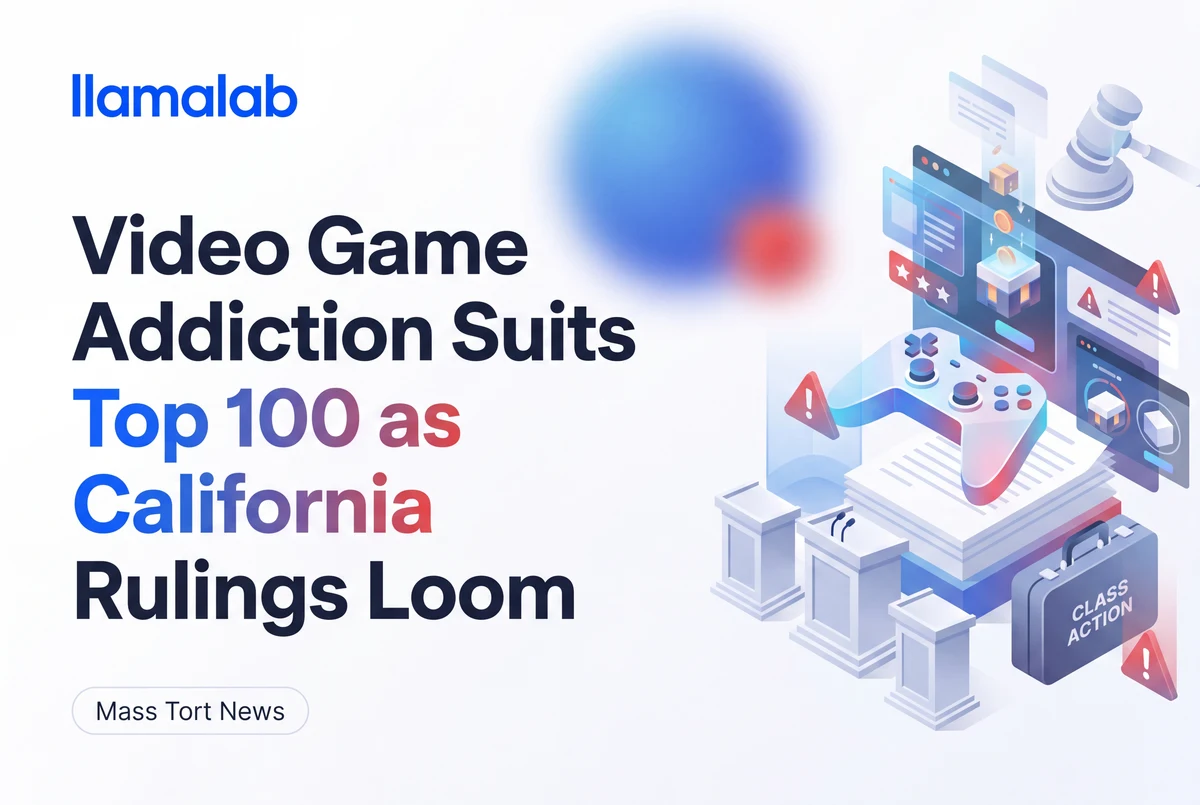
Video Game Addiction Suits Top 100 as California Rulings Loom

CEO & Founder at LlamaLab
Video Game Addiction Litigation Passes 100 Cases With First Major Rulings Ahead
More than 100 video game addiction lawsuits are coordinated in Los Angeles Superior Court under JCCP No. 5363. Judge Lawrence P. Riff is evaluating an initial wave of arbitration, anti-SLAPP, and demurrer motions that will establish whether claims proceed in coordinated state litigation or individual arbitration forums. The California proceeding functions as the primary national venue following the Judicial Panel on Multidistrict Litigation's December 10, 2025 denial of a federal MDL (proposed MDL 3168) targeting titles including Roblox, Fortnite, and Minecraft.
Plaintiffs allege that video game publishers (including Roblox Corporation, Epic Games, Microsoft, and Activision Blizzard) utilized behavioral neuroscience principles to develop compulsive engagement loops and failed to warn parents of psychological injury risks. Concurrently, a Los Angeles jury returned a roughly $6 million verdict against Meta and YouTube in a related social media trial in March 2026, while Roblox disclosed a $57 million litigation reserve following an initial state enforcement settlement.
In JCCP 5363 before Judge Riff, with filings continuing statewide
First trial verdict on addictive-design theories, LA, March 2026
Disclosed reserve for state regulatory and child-safety settlements
Roblox resolution with Alabama, followed by filings in Nebraska and Oklahoma
Procedural Background
April-May 2025: Coordination Established
California Judicial Council coordinates claims as JCCP No. 5363 in Los Angeles Superior Court under Judge Lawrence P. Riff
July-September 2025: Docket Expansion
Roblox and multi-publisher cases consolidated; initial arbitration discovery pools selected
December 10, 2025: Federal MDL Denied
JPML declines national consolidation; California coordinated proceeding becomes the primary national forum
March 2026: Addictive-Design Verdict
Los Angeles jury awards ~$6M in the first trial addressing behavioral addiction from digital engagement features
April-May 2026: State Regulatory Actions
Alabama settles enforcement action for $12.2M; Roblox reports $57M settlement reserve
Summer 2026: Threshold Motion Rulings
Court evaluates motions regarding mandatory arbitration enforceability, anti-SLAPP protections, and demurrer challenges
Core Legal Arguments
Motions in JCCP 5363 center on contract enforceability and tort liability:
Plaintiffs' Core Allegations
- Game mechanics designed around variable reward schedules and operant conditioning loops
- Microtransaction and virtual currency architectures that monetize compulsive user behavior
- Failure to warn parents regarding clinical addiction and psychological injury risks
- Documented injuries including gaming disorder (ICD-11), severe depression, and academic withdrawal
Defendants' Primary Defenses
- Terms of service mandate individual arbitration of all user disputes
- First Amendment and anti-SLAPP protections apply to game design and software creative choices
- Lack of established specific causation connecting game play to psychiatric diagnoses
- Parental supervision tools and device controls operate as intervening factors
The World Health Organization recognized gaming disorder in the ICD-11 (diagnostic code 6C51) in 2019, providing a diagnostic reference for clinical causation. Related legal frameworks are detailed in our social media addiction litigation update and analysis of the New Mexico child safety verdict.
After federal judges declined to create a national MDL in December 2025, California became the center of this litigation for the entire country.
LegalScoopsRoblox Addiction Litigation Coverage
Medical Records and Proof of Injury
Unlike pharmaceutical mass torts with clear prescription logs, video game addiction claims turn on longitudinal behavioral health documentation:
- Pediatric and Primary Care Records: Documenting baseline development, physical health, and early behavioral consultations.
- Psychiatric and Counseling Records: Diagnostic evaluations for gaming disorder, major depression, generalized anxiety, or ADHD, including treatment plans and clinical assessments.
- Academic and School Records: Attendance records, report cards, individualized education programs (IEPs), and guidance counselor evaluations.
- Platform Account Records: Play logs, session timestamps, and purchase receipts from platform accounts and linked app stores.
Because mental health treatment often spans multiple therapists, school counselors, and pediatric clinics, gathering complete records is a central operational requirement. Reverse search uses insurance data to fill in treatment gaps clients don't always remember, surfacing facilities, dates, and clinicians as needed.
Records return in 4 days on average, with roughly 30-40% returned same-day on electronic requests. Because medical record retrieval is an itemized case disbursement, invoices flow through to settlement statements.
Upcoming Milestones
Key Points
Essential takeaways from this article
Evidentiary Demands in Emerging Addiction Dockets
Video game addiction litigation is advancing through critical threshold motions in California state court. As courts evaluate arbitration clauses and design defect theories, case viability depends on documented medical evidence: verified clinical diagnoses, therapy progress notes, and complete treatment chronologies.
Firms evaluating video game addiction intakes must assemble objective clinical records early to substantiate specific causation and position claims for discovery.
Screening Video Game Addiction Intakes?
LlamaLab retrieves pediatric, psychiatric, and counseling records in 4 days on average, with ~30-40% returned same-day on electronic requests. Identify missing providers and build verified case files.
Sources: Lawsuits Journal: Video Game Addiction Litigation, LegalScoops: Roblox JCCP Update, California Personal Injury Lawyers Blog: JCCP 5363, King Law: MDL Petition Coverage. Case counts current as of June 2026.
This article provides general information about video game addiction litigation developments and should not be construed as legal or medical advice. Consult with qualified professionals for advice specific to your situation.
Stay Updated with Latest Insights
Get the latest articles about medical record retrieval and legal tech delivered to your inbox.