JPML Weighs New PFAS MDL Over Firefighter Gear

CEO & Founder at LlamaLab
A Second PFAS Mass Tort Comes Before the JPML
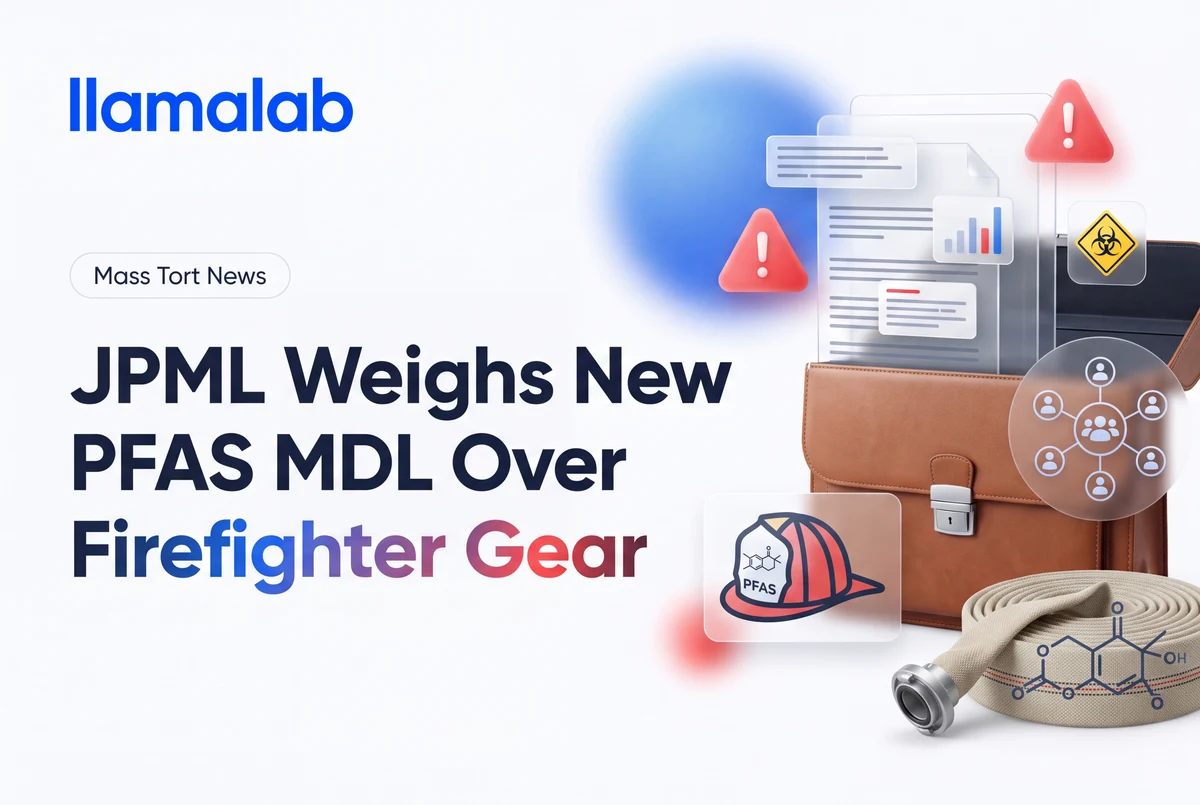
The Judicial Panel on Multidistrict Litigation hears oral argument on July 30, 2026 in Asheville, North Carolina on whether to create a new multidistrict litigation for claims alleging that firefighter turnout gear exposes first responders to PFAS. The proposed docket, MDL 3191, would operate alongside the separate aqueous film-forming foam litigation that holds 15,244 pending cases in the District of South Carolina.
The distinction between these litigations is significant. AFFF claims focus on chemicals released into groundwater and drinking water supplies. Turnout gear claims allege that protective garments are the direct exposure source, worn against the skin across a career. That shifts the proof from environmental water sampling to individual occupational and medical histories.
Pending in AFFF MDL 2873 as of July 1, 2026 (JPML statistics)
Higher cancer incidence and mortality among firefighters vs. the U.S. population (NIOSH)
Median PFAS in treated outer-shell gear textiles after heat exposure, up from 1,430 when new (NIST)
Procedural Background
The City of Rochester, New York moved on May 11, 2026 to centralize five class actions in the District of Minnesota, arguing the cases share common factual questions and named defendants including 3M, according to HarrisMartin. The actions involve 20 plaintiffs, and the Panel has three available options: create a new MDL, transfer the claims into the existing AFFF docket, or leave them to proceed in their individual districts, InsideEPA reported on July 23.
U.S. District Judge Richard Gergel, presiding over the AFFF MDL, requested in August 2025 to coordinate turnout gear claims within MDL 2873. However, the Panel previously rejected consolidation. In orders issued in December 2024 and December 2025, the JPML held that turnout-gear-only lawsuits do not involve AFFF allegations on their face and do not warrant expanding MDL 2873.
Defendants named across turnout gear lawsuits include equipment manufacturers and textile suppliers: Honeywell Safety Products, W.L. Gore & Associates, Milliken & Company, Lion Group, Globe Manufacturing, Fire-Dex, Morning Pride Manufacturing, PBI Performance Products, Elevate Textiles, Safety Components Fabric Technologies, and Stedfast USA.
AFFF Claims (MDL 2873)
- Exposure pathway: PFAS released into groundwater and municipal drinking water supplies
- Typical sites: military bases, commercial airports, and industrial fire training centers
- Plaintiff mix: firefighters, base-adjacent residents, and public water utilities
- Core proof: environmental water sampling, site history, and residency or service records
- Status: 15,244 pending actions before Judge Gergel in D.S.C.
Turnout Gear Claims (Proposed MDL 3191)
- Exposure pathway: PFAS in protective textile layers via direct dermal contact and inhalation
- Typical setting: routine gear wear, training exercises, and post-fire overhaul operations
- Plaintiff mix: individual firefighters and municipal procurement authorities
- Core proof: department employment records, gear assignment logs, and clinical diagnosis files
- Status: five actions, 20 plaintiffs, centralization argument scheduled for July 30, 2026
Scientific Evidence Supporting the Claims
Two primary research areas support turnout gear litigation:
First, the International Agency for Research on Cancer classified occupational exposure as a firefighter as carcinogenic to humans (Group 1, the agency's highest evidence category) in its 2022 monograph, as the American Cancer Society explains. A 2026 systematic review in the Journal of Occupational Health summarizes NIOSH findings that firefighters experience a 9% higher cancer incidence and 14% higher cancer mortality than the general U.S. population.
Second, NIST Technical Note 2260 evaluated 51 PFAS compounds across 20 turnout gear textiles under abrasion, heat, laundering, and weathering. Median summed PFAS in water-repellent-treated outer shells rose from 1,430 µg/kg when new to 3,500 µg/kg with abrasion and 4,420 µg/kg after elevated temperature exposure.
Individual Proof Requirements
Implications of a New MDL
Creating MDL 3191 would initiate coordinated pretrial proceedings, master pleadings, and Plaintiff Fact Sheet protocols.
Plaintiff Fact Sheets in occupational dockets require documenting service dates, employer histories, gear assignment logs, and complete treating provider lists. Because firefighters often treat with numerous specialists over a multi-decade career, locating missing treatment facilities is essential.
LlamaLab retrieves records in 4 days on average (with ~30-40% returned same-day on electronic requests) and uses insurance data to surface treatment locations clients don't always remember across thirty-year careers. Invoices are itemized per case to flow through as recoverable case disbursements on settlement statements.
Summary
The JPML's decision following the July 30 hearing will determine the procedural path for turnout gear litigation. Regardless of forum, the underlying claims require verified employment histories, gear assignment records, and comprehensive medical diagnosis files.
Firms handling firefighter claims should assemble complete occupational and clinical timelines early to prepare for initial discovery requests.
Building Firefighter Cancer Claims?
LlamaLab retrieves oncology, pathology, and occupational health records in 4 days on average, using reverse provider search with insurance data to fill in treatment gaps.
Sources: JPML July 2026 Hearing Session Order, JPML Pending MDL Dockets, July 1, 2026, JPML Orders Denying Transfer, HarrisMartin, InsideEPA (July 23, 2026), AboutLawsuits, IARC Monographs Vol. 132, NIST Technical Note 2260, Journal of Occupational Health (2026). This article is for informational purposes only and does not constitute legal or medical advice.
Stay Updated with Latest Insights
Get the latest articles about medical record retrieval and legal tech delivered to your inbox.