AI in Medical Record Retrieval: What It Does for Law Firms

CTO at LlamaLab
AI in Medical Record Retrieval: What It Actually Does for Law Firms
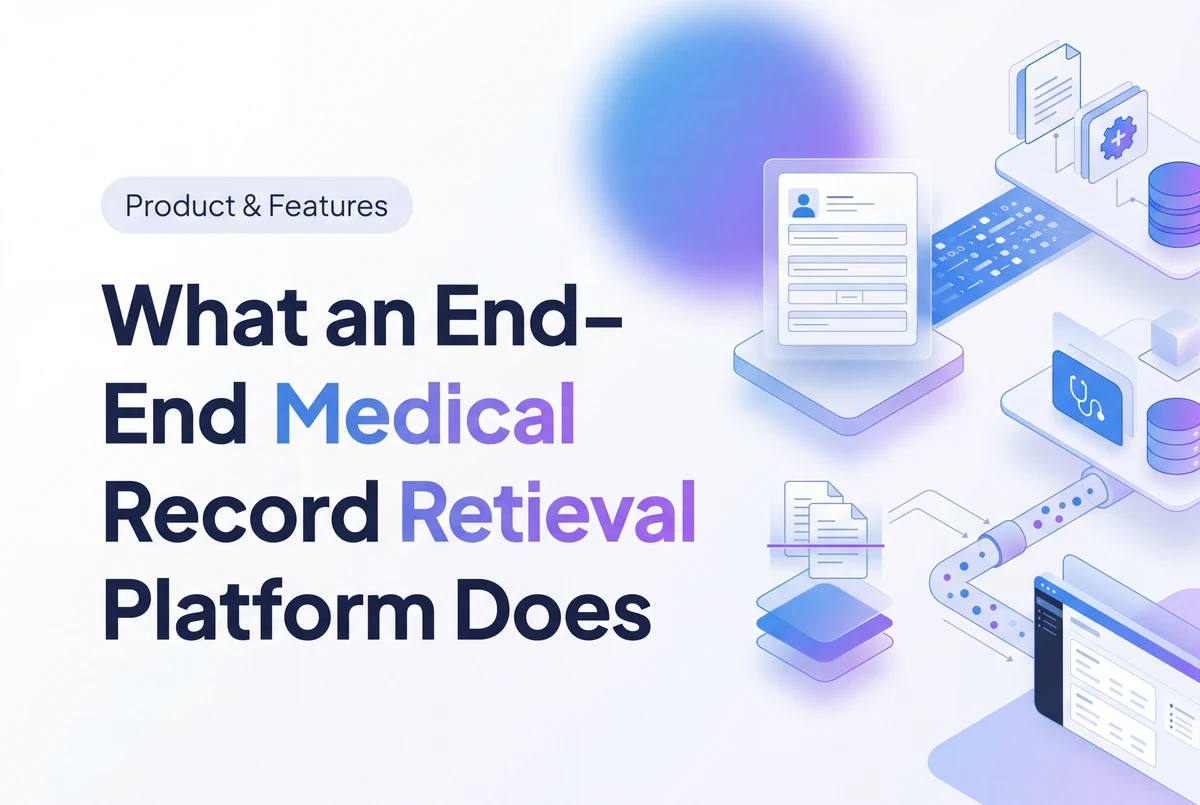
AI in medical record retrieval gets marketed as though it collapses the entire workflow into a button. It does not. Retrieval is still governed by HIPAA authorizations, statutory response windows, and records departments that answer on their own schedule. What AI changes is the portion of the process a law firm actually controls: which providers get requested, how cleanly each request goes out the door, how quickly a non-response gets escalated, and whether anyone notices that a production came back missing the operative report that mattered.
That distinction is worth getting right before a firm buys anything. The gap between a retrieval workflow that uses AI well and one that does not is measured in weeks of case velocity, not in whether a demo looks impressive.
Key Points
Essential takeaways from this article
Where AI actually touches the retrieval workflow
A records request has four control points between the signed authorization and a usable file. AI is useful at all four, and for different reasons at each.
1. Identify
Surface every treating provider, including the ones the client did not mention at intake, so the request set is complete on the first pass instead of the third.
2. Scope and validate
Route each request to the correct custodian, name the specific document types the case needs, and check the authorization against that state's requirements before it goes out.
3. Chase
Track every open request against its expected response window and escalate non-responders automatically rather than when a paralegal happens to review the log.
4. Verify and qualify
Check the production against what was requested, flag gaps for a supplemental request, and index the clinical content so the file arrives ready for evaluation.
Provider identification is where the largest gains sit
Clients do not remember every place they were treated. They remember the hospital and their primary care doctor, and they forget the urgent care visit, the imaging center, the physical therapist, and the specialist they saw twice. Those forgotten providers are disproportionately likely to hold the documentation that establishes causation or severity.
The traditional fix is a paralegal working backward from insurance statements and pharmacy records. It works, and it consumes hours per case. AI-powered provider discovery does the same reconstruction from insurance data and returns a provider list rather than a starting point for phone calls. The practical effect is not that any single request moves faster. It is that the firm sends one complete round of requests instead of discovering a missing provider six weeks in and restarting the clock on that record.
Scoping and validation prevent the rework loop
A request that names the wrong custodian, omits the document types the case actually needs, or carries an authorization that does not satisfy the destination state's requirements will come back rejected or incomplete. Every one of those costs a full cycle.
Validating the request before submission is unglamorous work that AI handles well, because it is pattern matching against known requirements rather than judgment. The value shows up as an absence: no rejection notice three weeks later, no supplemental request for the nursing flow sheets the original request never mentioned.
Escalation removes the waiting-to-be-noticed problem
Most retrieval delay is not a provider taking a long time. It is a request sitting unanswered while nobody is watching it. Automated tracking against expected response windows turns that from a staffing question into a system behavior. This is also the least interesting use of AI in the workflow and one of the most valuable.
Completeness and clinical qualification on arrival
A production arriving is not the same as a case being ready. Records come back unindexed, out of order, and sometimes short of what was requested. Automated completeness checking compares what arrived against what was asked for, and AI-driven clinical analysis surfaces the diagnoses, procedures, and treatment dates that determine whether the case qualifies, without an attorney reading 800 pages to find out.
Manual Retrieval vs AI-Assisted Retrieval
Manual Workflow
Provider List From Client Recall
Request set is built from what the client remembers, with missing providers surfacing weeks later and restarting the retrieval clock
Rework Discovered After the Fact
Rejected authorizations and mis-scoped requests are found when the rejection arrives, costing a full cycle each time
Follow-Up on Human Cadence
Non-responses sit until a paralegal reviews the tracking log, so idle time is a function of staffing rather than the provider
AI-Assisted Workflow
Provider List From Data
Reverse search uses insurance data to surface treatment locations the client did not mention, so the first round of requests is the complete round
Validation Before Submission
Custodian routing, document scoping, and state authorization requirements are checked before the request leaves, not after it bounces
Escalation on System Cadence
Every open request is tracked against its response window and escalated automatically, with records back in 4 days on average
What AI does not fix
Being clear about the ceiling is more useful than another feature list, and it is the fastest way to tell a serious retrieval vendor from a marketing one.
Four Limits No Retrieval Technology Removes
There is a second limit worth naming. Clinical qualification is a judgment task, and an automated summary that no human checks is a liability rather than an efficiency. The useful design is AI that narrows a thousand pages to the twenty that matter and a person who reads those twenty, not AI that replaces the reading.
How to test an AI retrieval claim before buying
Nearly every retrieval vendor now says "AI-powered." The phrase carries no information on its own. Three questions separate capability from category:
Which step does it perform? A vendor that cannot name provider discovery, authorization validation, escalation, or clinical indexing specifically is describing a market, not a product.
What happens when it is wrong? Ask about the review layer. If provider discovery returns a bad address or clinical indexing mislabels a diagnosis, someone should catch it before the file reaches an attorney.
How is it billed? This is the question most firms skip and the one with the largest financial consequence. Per-seat licenses, platform fees, and technology surcharges are firm overhead that no settlement reimburses. Per-case retrieval invoices are advanced by the firm and recovered as case disbursements from settlement proceeds. Two vendors can quote similar totals and produce entirely different results on the firm's P&L depending on how the AI portion is classified. The comparison of retrieval cost structures is worth running before the demo, not after.
What this changes for a firm's operations
The honest summary is that AI in medical records retrieval does not make providers faster. It removes the dead time around them, which in most firms is the larger number. When provider identification, request validation, escalation, and completeness checking all run without a person driving them, medical record retrieval for law firms stops being a staffing problem that scales with case volume and becomes a per-case cost that scales with the docket.
For a firm adding cases, that is the difference between hiring against growth and absorbing it.
See What AI-Assisted Retrieval Looks Like on Your Caseload
LlamaLab handles provider discovery, request validation, escalation, and clinical qualification on one per-case invoice with no per-seat fees. Records come back in 4 days on average, with roughly 30-40% returned same day.
Stay Updated with Latest Insights
Get the latest articles about medical record retrieval and legal tech delivered to your inbox.