Legal AI Hits 91% as Verification Becomes the Cost

CEO & Founder at LlamaLab
Legal AI Reaches 91% Adoption as Verification Becomes the Real Cost
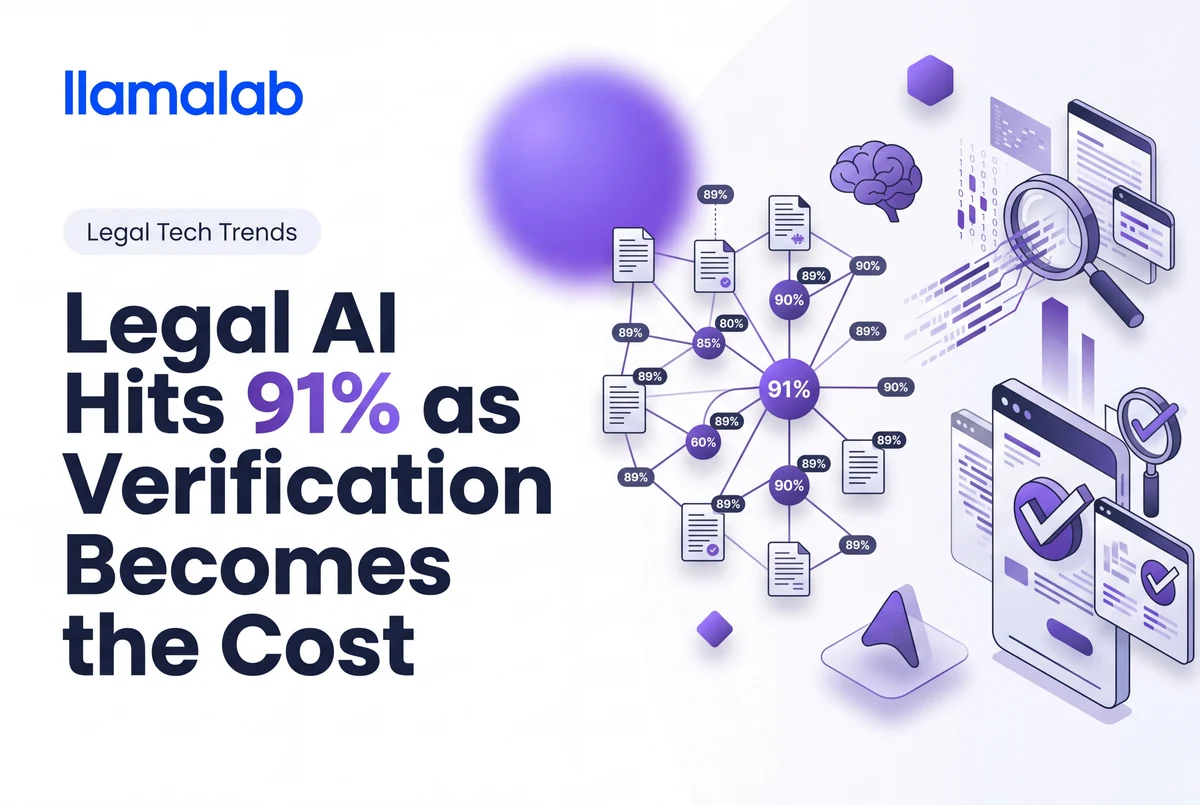
Generative AI use is now effectively universal in legal work, and the industry's principal concern has shifted from whether to adopt it to whether its output can be trusted. The Secretariat and ACEDS 2026 Artificial Intelligence Report, published July 23, 2026, found that 91% of respondents used generative AI in the past year, while concern about hallucinations rose 15 points year over year to 46%, overtaking cost to become the second-largest barrier to adoption behind data privacy at 57%.
The accuracy problem is no longer abstract. As of July 25, 2026, the AI Hallucination Cases database maintained by HEC Paris research fellow Damien Charlotin listed 1,809 court and tribunal decisions worldwide addressing AI-generated fabrications in filings. Separate research published July 8 by Morae found that only 33% of senior legal professionals trust the results of AI-assisted legal work.
Used generative AI in the past year (Secretariat and ACEDS, July 2026)
Cite hallucinations as an adoption barrier, up from 31% in 2025 (Secretariat and ACEDS)
Court rulings addressing AI-hallucinated filings as of July 25, 2026 (Charlotin database)
Where the Adoption Curve Actually Sits
The headline number describes reach, not maturity. The same report found 59% of respondents still characterize their organization's approach to AI as cautious, and 64% expect AI investment to increase over the next 12 months. Adoption and confidence are moving on different timelines.
The full report also documents a shift in what AI is used for and which tools do the work. Document drafting is now the leading use case at 66%, up 19 points, which puts generative AI in the position of writing first drafts rather than searching or summarizing. Tool preference is fragmenting rather than consolidating: Claude more than doubled from 15% to 33% while ChatGPT fell from 76% to 61%.
Largest single-year increase of any adoption barrier measured
Up 19 points; now the leading application of generative AI in legal work
More than doubled year over year as tool choice fragments
Declined as organizations match specific tools to specific tasks
One caveat belongs with these numbers. The 2026 survey drew from a different respondent mix than 2025: organizations with 250 or more employees fell from 56% of respondents to 41%, while firms of 11 to 50 employees more than doubled from 11% to 23%. Some of the year-over-year movement reflects a broader and smaller-firm sample rather than pure behavioral change.
The Trust Gap Has Become a Cost Problem
The more consequential finding across the 2026 research is not that lawyers distrust AI output. It is what that distrust costs. Morae's survey of 850 senior legal professionals across the United States, United Kingdom, Australia, and the Middle East found that 89% believe AI-generated legal work should be checked by a human before use, and 48% report that humans always or often materially change AI outputs before they can be used.
Then the number that matters operationally: 67% are concerned that the cost of human verification and oversight may outweigh the efficiency benefits AI provides. Half report high concern about liability if AI-assisted work produces errors.
The Verification Math
Courts Are Keeping Score, and the Record Is Public
The hallucination database is the clearest available measure of what happens when unverified output reaches a courtroom. It tracks decisions where a court engaged with AI-generated fabrications, citations to cases that do not exist, quotations that appear in no opinion, real citations attached to the wrong holding.
Two features of that count deserve attention. First, it undercounts by construction: it records only instances where a judge caught the problem and wrote about it. Fabrications that opposing counsel quietly flagged, or that slipped through entirely, do not appear. Second, the consequences attach to named attorneys in published, searchable decisions. A July 24, 2026 decision in the Western District of Washington, LeDoux v. Outliers, imposed a $3,000 sanction over fabricated case law and false quotations traced to ChatGPT and Claude, per the database record.
Courts are also moving from case-by-case sanctions to standing rules governing AI use in filings, which changes the compliance posture from reactive to documented.
What Separates Verifiable Tools From Unverifiable Ones
The distinction that matters is whether a tool's output can be traced back to a source. In document-heavy practice areas, that is a concrete design property rather than a marketing claim.
Medical evidence work illustrates the difference. A model asked to summarize 4,000 pages of records can produce a fluent narrative that a paralegal must then verify page by page, which returns the work to where it started. A system that extracts each fact with a citation to the page it came from produces something a reviewer can confirm by clicking through. LlamaLab is built on the second approach, and it is the same principle behind the broader category shift Secretariat identified: tools that solve for both privacy and accuracy hold the advantage.
Secretariat Managing Director Richard Finkelman noted that recent cases are bringing the risks into sharper focus, "particularly around hallucinations and data privacy," and identified expert discovery as the next frontier for AI adoption, "while adoption today remains nascent, we expect it to shift rapidly toward more mainstream use over the next 12 months."
What Firms Should Do in the Next Two Quarters
Key Points
Essential takeaways from this article
The Bottom Line
Adoption is settled. At 91%, generative AI is a baseline tool rather than an experiment, and the surveys measuring adoption rates are approaching the end of their usefulness.
The open question for 2027 is whether firms can verify what these tools produce without spending the time the tools were meant to save. That makes traceability, the ability to check any output against the record it came from, the property worth evaluating in every purchase decision.
Want AI Output You Can Actually Verify?
LlamaLab retrieves medical records in 4 days on average and extracts clinical evidence with direct page citations for each fact, making verification straightforward.
Sources: Secretariat and ACEDS 2026 Artificial Intelligence Report and full report PDF, Morae AI in Legal Report 2026 via GlobeNewswire, AI Hallucination Cases database, Damien Charlotin, Wolters Kluwer Future Ready Lawyer 2026. Survey figures reflect the reports as published; the hallucination case count changes daily and is stated as of July 25, 2026.
Stay Updated with Latest Insights
Get the latest articles about medical record retrieval and legal tech delivered to your inbox.