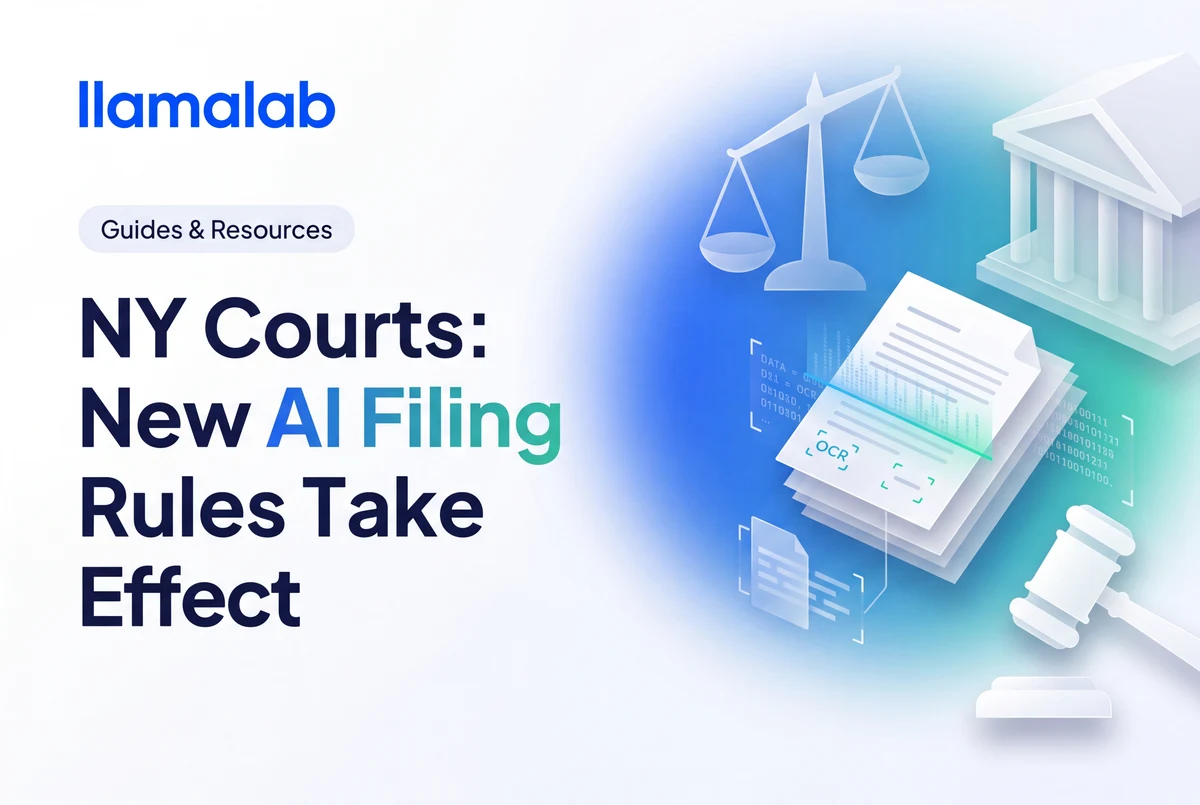
NY Courts: New AI Filing Rules Take Effect

CEO & Founder at LlamaLab
New York's Part 161 AI Court Rules Are Live: Disclosure Is Optional, Fabrication Is Not
New York's statewide court rule on artificial intelligence in litigation, 22 NYCRR Part 161, took effect June 1, 2026. The rule sets a system-wide no-disclosure default: lawyers and parties using AI in court papers are not required to announce that use. Individual courts may then adopt an Appendix A Model Rule under which signing a paper certifies it contains no fabricated AI content.
For personal injury and mass tort firms filing in New York, or supervising New York counsel, the practical shift is from "Do we disclose AI?" to "Can we prove every factual assertion in this filing?"
Effective date of 22 NYCRR Part 161 statewide AI court rules
Statewide mandatory AI-use disclosure under the Part 161 default
U.S. states/DC with formal AI ethics opinions as of mid-2026 (context)
How Part 161 Actually Works
Part 161 separates disclosure policy from accuracy certification:
- Statewide default: No duty to tell the court that AI assisted a filing.
- Appendix A opt-in: A court that adopts the Model Rule converts the attorney's signature into a certification that the paper contains no fabricated AI-generated content.
- Per-court variation: Adoption is not uniform. A firm filing across Commercial Division parts, Supreme Court parts, and federal courts sitting in New York still needs a part-by-part check.
Earlier Commercial Division proposals on AI disclosure were effectively absorbed into this framework rather than remaining a separate statewide mandate.
The Real Risk Is Hallucinated Facts, Not the Logo on the Tool
Ethics Overlay: ABA Opinion 512 Still Applies
ABA Formal Opinion 512 (July 29, 2024) did not create new Model Rules. It applied existing duties, competence (including technology), confidentiality, communication, supervision, and reasonable fees, to generative AI. State bars that followed largely tracked that approach.
Part 161 is a court procedure layer. It does not preempt ethics opinions, and it does not eliminate federal judges' individual standing orders (Texas and other districts already show wide variation). New York firms need both: ethics compliance plus local certification status.
Part 161 vs. Ethics Duties
| Rule Layer | What It Requires |
|---|---|
| Part 161 default | No statewide duty to disclose AI use in court papers |
| Appendix A (if adopted) | Signature certifies no fabricated AI content in the filing |
| ABA Opinion 512 / NY ethics | Competence, confidentiality, supervision, candor: always on |
| Federal / judge standing orders | May impose separate disclosure or prohibition rules |
What This Means for Medical-Record AI Workflows
Plaintiff firms increasingly use AI to summarize records, build chronologies, and draft demand-letter medical sections. Under Part 161, the safe operating model is unchanged, and more urgent:
Source-link every clinical claim
AI chronologies should point to page-level medical sources. If a filing asserts "revision surgery on July 12, 2020," the operative report must be in the file.
Keep humans in the signature path
Associates and vendors can accelerate drafting. The signing attorney still owns fabricated-content risk in Appendix A courts.
Treat PHI like a BA obligation
Confidentiality duties under Opinion 512 align with HIPAA business-associate controls when firms handle protected health information, a theme OCR continues to enforce against professional services firms.
Tools purpose-built for legal medical evidence, including LlamaLab, are designed for source-linked retrieval and review rather than freeform generation, which is the compliance difference that matters under certification regimes. Related firm-AI governance context: legal AI adoption vs. policy gaps.
Looking Ahead
Key Points
Essential takeaways from this article
The Bottom Line
Part 161 lowers the disclosure burden and raises the accuracy stakes. New York firms can use AI without labeling every brief, but they cannot file invented facts. The winners will be practices that treat AI medical analysis as an evidence pipeline with audit trails, not a shortcut around verification.
Need Source-Linked Medical Evidence?
LlamaLab retrieves medical records in 4 days on average and structures clinical evidence with direct page citations, keeping litigation chronologies verifiable.
Sources: Legal AI Governance: ABA 512 vs. state bars, Reuters on ABA Formal Opinion 512 (July 29, 2024), ABA Formal Opinion 512. Confirm current local court adoption before filing.
Stay Updated with Latest Insights
Get the latest articles about medical record retrieval and legal tech delivered to your inbox.